Your dog eats feces and this has left you a little frustrated and worried. Well, you are not alone. Coprophagia is a significant concern for the behavior of dogs of all ages, sizes and breeds. A dog may eat its own stool, usually only when at home, or seek the feces of other dogs or animals when outdoors. In some cases dogs will try to eat cat feces.
Although this is not uncommon behavior, it should definitely be addressed. Not only can a dog become ill from eating feces, in some cases it indicates an underlying issue that needs to be resolved.
Here we will cover everything you need to know if your puppy or dog eats feces, including how you can prevent it.
Can a dog get sick from eating feces?
Depending on whether a dog eats its own or another animal’s, there are health risks:
Eating its own feces: can lead to stomach and/or intestinal upset, may indicate a lack of proper nutrition (which in itself can lead to problems in both the short and long term), and any dog being treated for worms can reinfect itself via eggs found in the feces during the process of ‘shedding’.
Eating the feces of other dogs: there are many parasites and diseases that can be spread if a dog eats another dog’s feces. Top concerns are worms (roundworms, whipworms, tapeworms, hookworms) and diseases including Campylobacter, coronavirus, cryptosporidiosis, giardiasis, parvovirus and salmonella.
Eating cat feces: a dog can contract worms from a cat, if she has worms and even if she is treated for them, via eggs that are found in feces during the process of ‘shedding’. Additionally, three diseases a dog commonly contracts by eating cat feces are Clostridium, Salmonella and Campylobacter.
Dog eats feces: Possible reasons
The reasons for coprophagia fall into 3 categories: health, nutrition and behavior.
1. Health
There are several diseases that have coprophagia as one of the symptoms; however, for most of these conditions there will be other, much more pronounced symptoms. That said, it is always wise to rule out the following if any of them are suspected. Health conditions in which coprophagia can be present are not limited to:
- Inflammatory bowel disease. Symptoms include diarrhea, vomiting, weight loss, gas and/or abdominal pain.
- Intestinal tumors or cancer. Symptoms include diarrhea, vomiting blood or stool, abdominal swelling, black or tarry stools and/or hypoglycemia (low blood sugar) which causes disorientation, difficulty walking and/or weakness.
- Intestinal bacterial overgrowth. Symptoms include larger or more frequent stools relative to food intake, vomiting, gas, weight loss, abdominal pain and/or increased appetite.
- Parasitic infection (including worms and some fungal infections). Signs of worms are very varied, depending on the type, but include vomiting, diarrhea, coughing, low energy, a bloated abdomen, changes in appetite (increased or decreased), weight loss, poor coat texture, skin irritations and occasionally worms seen in the dog’s stool.
- Lymphangiectasia (intestinal disease). Symptoms include weight loss, diarrhea, abdominal pain, swelling in the limbs, vomiting and/or coughing.
- Age-related (young or old) problems with nutrient absorption. Even without health problems, very young puppies or older adult dogs may simply have trouble absorbing nutrients.
2. Nutritional value
This is about fillers; these are “empty” ingredients intended to bulk up dog food (often used as a cost-saving tactic by manufacturers of cheap, inferior dog food). Fillers include corn, corn bran, soy, wheat, hulls, chaff, some “meals”, by-products, certain oats, mill runs and more.
If a dog eats 1 cup of superior healthy food, he receives the benefits (fuel and nutrients) of 1 cup of food. If a dog eats 1 cup of inferior food with fillers, he is first full (he has technically consumed 1 cup of food) and gets some fuel and nutrients, but also many ingredients that the body cannot process. A large portion of the fillers will pass through the body and provide nothing.
So that 1 cup was actually only 3/4 cup or less. Although it seems like enough to eat, a dog can be missing a lot of carbohydrates, healthy fats, proteins and a wide range of vitamins and minerals. If this applies to your dog, it can cause your dog to look for another food source. And a dog’s feces can be a tempting food source; if the food contained fillers, many of those were not even digested by the body; there are food bits (albeit of low value) mixed in the stool.
Furthermore, there is a theory that a vitamin B deficiency can lead to coprophagy, although other vitamins or minerals are also suspected.
3. Behavior
This includes:
- Boredom. In the absence of stimulation, boredom can set in quickly, leading a dog to inspect and eventually eat its feces.
- Stress. This can be separation anxiety, a chaotic environment, moving to a new home, or any other event or situation that a dog finds overwhelming. This kind of stress in dogs can cause various behavioral problems.
- Unintentional training. The fuss that occurs when a dog eats its feces (rushing, inspecting the dog, talking for about a minute and a half) can lead to it repeating the behavior to get attention.
Note: although some sources claim it is, there is no evidence that a dog eats feces as a result of the ‘hiding’ of an accident. There is also no evidence that coprophagy is a continuation of puppy behavior, because young pups do not eat their own feces.
How to prevent your dog from eating feces
Considering the causes mentioned above, there are three key things that can help:
#1 Offer filler-free, well-balanced, top-quality meals and snacks. Avoid kibble containing corn, wheat, soy, hulls, chaff, and other fillers. Ensure the food contains all vitamins and minerals.
One of the absolute best kibbles is Edgard Cooper. This is simply one of the top brands without additives, no synthetic preservatives, and premium ingredients. The original formula is based on turkey and chicken. There is also an Ocean recipe based on whitefish, herring, salmon and menhaden, a free-range recipe based on duck and lamb, and even a reduced-fat recipe. These also provide excellent levels of omegas and antioxidants.
There are several good choices for treats. Keep in mind: dry is best for snacks between meals and chewy/moist is best for rewards. For more information about healthy snacks for your dog you can find additional guidance.
For dry treats to give your dog between meals, tripe sticks are great. These meet the same standards of containing only healthy ingredients. They are crunchy on the outside and have real marrow on the inside. There is both beef and turkey. These treats are fantastic for training rewards. Because it’s important that your dog finds training rewards especially tasty, there are some great choices: chicken & lamb, chicken & venison, beef & turkey, turkey & duck, and lamb & salmon.
#2 Limit the ability to eat feces. There are several things you can do: In your yard / outdoors:
- Clean up feces in your yard. This includes both your dog’s stool and that of others (your neighbors’ dogs, etc.). You can do this with traditional poop bags. Attaching a poop bag holder to your dog’s leash makes this easy. Or you might want to use a ‘poop scooper’. If weather permits, you can use a hose to spray the feces away; however, keep in mind that if the feces contain worms, this can contaminate the soil.
- Supervise. While opening the back door and simply letting your dog out is certainly easier, it’s better to supervise if your dog has a strong coprophagia problem until other measures begin to work to stop the urge.
- Leash control. When you take your dog outside, put it on a leash and harness. As the leader you are responsible for where your dog goes and what he does. Although there should be no old droppings in the yard (if you follow the suggestion to keep that tidy), immediately give your dog a ‘No’ and send him away if your dog goes toward something. If your dog is going to investigate a pile of poop during a walk, give a good jerk (no problem if you use a harness) and keep him moving. If you see it happening, stay calm. If your dog eats feces because of the sudden surge of attention that occurs, do not allow that behavior.
Home alone: Work on a stimulating environment. Note that these steps can also help with separation anxiety.
- Provide lots of interactive toys to keep your dog occupied. This includes interactive toys that respond to a dog’s touch, such as toys, squeakers and/or crinkle toys. Additionally, treat-dispensing toys like the interactive OurPets IQ toys are always useful.
- Leave a TV on (some cable providers offer channels made especially for dogs to enjoy) or play music.
- Adjust breakfast time. In general, when a dog eats, this will cause a bowel movement after a certain period. If you can set breakfast an hour later, this may lead to a bowel movement that happens later in the day, thereby creating a shorter time window during which the feces are present for your dog to possibly ingest.
#3 Try a deterrent or aid. Ensuring optional nutrition and limiting access should be your main focus, because only a few deterrents work, and for those that do, they don’t work for all dogs across the board. What works for one dog may not work at all for another. Moreover, tolerance can develop; what works well now may later lose its effectiveness, which over time may require changing methods. So let’s look at what you shouldn’t waste your time on and which are worth trying:
Do not use:
X Hot sauce. The idea is to sneak up to a fresh pile of poop and drizzle it over the pile; later, when your dog comes by to inspect the stool, the hot sauce will burn its mouth, creating such an unpleasant experience that there will be no future attempts. This method does not solve underlying problems and doesn’t help if a dog eats its stool when left home alone. Furthermore, hot sauce can cause real burns to the mouth, cause stomach upset, and frighten a dog, making this unethical.
X Any supplement or aid containing MSG (monosodium glutamate). This can cause mild to severe allergic reactions. It is included in MANY coprophagy supplements and is found in many meat tenderizers (a home remedy). Read the ingredients on the packaging of any supplement you plan to use!
What can work:
1) Pineapple. It contains bromelain, an enzyme that helps with protein absorption and aids digestion. Increased protein absorption may possibly reduce the urge to seek other food sources. There is anecdotal evidence that this can make stool taste bad and thus act as a deterrent. For a puppy, crushed pineapple can be given; the portion is usually 2 teaspoons per meal. For an adult dog, pieces of pineapple can be given; serving size is 7 to 8 pieces per meal.
2) Pumpkin. 100% real pumpkin is a great food to have on hand because it can help with digestive issues such as constipation or diarrhea. Because it works with digestion, it can help with nutrient absorption, potentially reducing the urge to seek other food sources. Use only real pumpkin, not canned pumpkin pie filling. Puppies can have 1 teaspoon per day and adult dogs can have 4 to 6 tablespoons per day. If you notice your dog’s stool is loose or too firm, you should reduce or stop the pumpkin.
3) Adolph’s meat tenderizer without MSG. This is one of the few meat tenderizers that contains no MSG, but it does contain papain, a protein-digesting enzyme derived from the papaya fruit. Because it works with digestion, it may help with nutrient absorption, potentially reducing the urge to seek other food sources. Additionally, there is anecdotal evidence that this makes stool taste bad and thus acts as a deterrent. Dosage is not established, as this is an off-label use. We do not recommend more than a sprinkle.
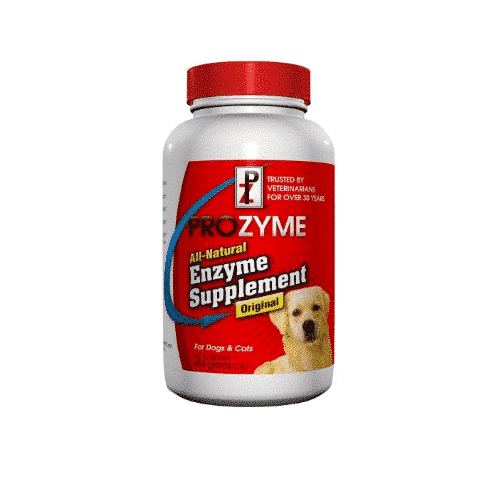
4) Prozyme powder. If your dog is eating well but still eats feces, you may want to consider this type of supplement, because it can help puppies and dogs that have difficulty absorbing nutrients. It can also help with issues such as loose stools. Greater absorption of nutrients may reduce the urge to seek other food sources. Read the label for dosing instructions. Trophy Prozyme Powder is a good choice for this; it is 100% natural and plant-based.
5) Unpleasant Mouth. This is a supplement designed to taste fine but make feces taste terrible. It is only effective for some dogs and may be worth trying; however, Unpleasant Mouth has fairly low reviews with only a handful of owners satisfied. At the time of writing there is no MSG and the ingredients are brewer’s yeast, cayenne pepper, biotin, vitamin B1, vitamin B2, vitamin B6, niacinamide, iron and copper. Serving size is 1 piece per 10 pounds.
How to stop a dog from eating cat feces
In addition to following the earlier recommendations, such as ensuring your dog is on a high-quality kibble and has things to keep busy, there are some things you can do. One is to keep the litter box out of your dog’s reach. Many owners choose the top of the washing machine. Another is to consider buying a covered litter box that prevents your dog from getting access to it.
A final word
Although many dogs eat their own feces or that of another animal, coprophagia is something that should not be ignored. Your dog can become ill and it often indicates the need to change something regarding the care of your puppy or dog.
For new dog owners experiencing problems with this behavior, puppy training tips can help correct unwanted behavior. It is also important to know how to discipline your dog properly without making the problem worse.
If this behavior is accompanied by other issues, such as house-training your puppy, it is important to choose a holistic approach.
For specific dog breeds there may be different nutritional needs. For example, Dachshund nutrition has specific requirements that can help with digestive issues.
It can also be helpful to consider which dog suits you if you’re thinking of getting a dog, so you’re prepared for breed-specific behaviors.
For new puppy owners there are also valuable puppy tips after purchase that can help prevent various behavioral problems.
