Welcoming a puppy into your family is a wonderful experience, but a good start really makes a difference for your dog’s future. Thanks to our many years of experience raising and guiding pups, we know how important the first weeks are. On this page we share practical and reliable puppy training tips about house training, socialization, training and daily routines. This way we help you step by step to raise your pup with confidence, calm and love into a balanced and happy dog.
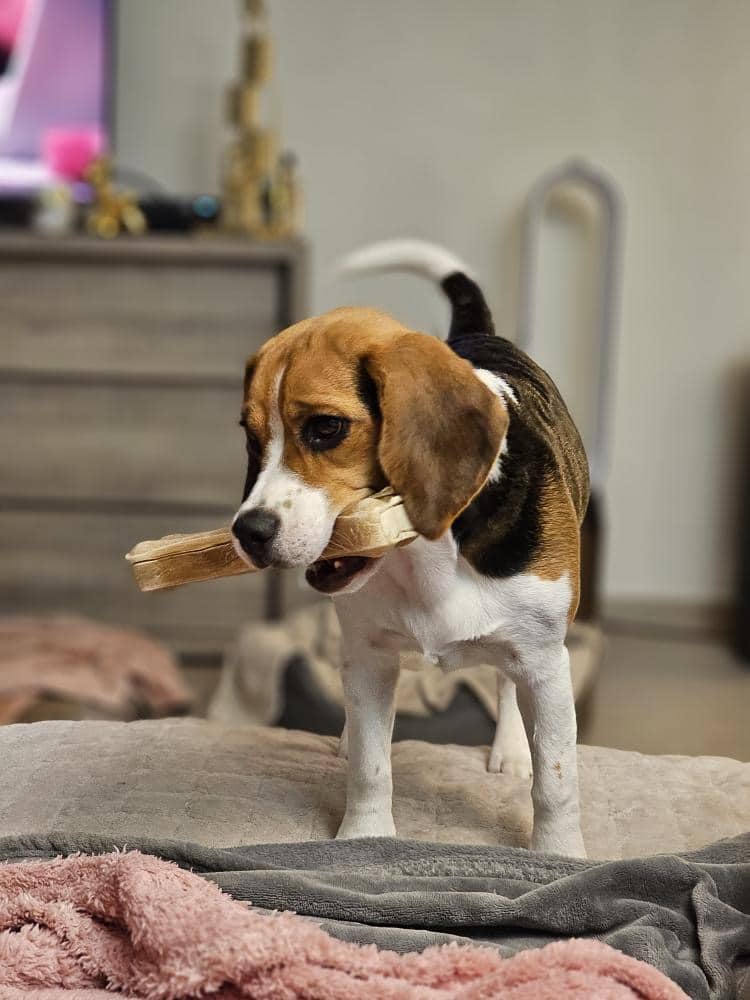
Raising a pup: Puppy training tips
Got a new pup at home?
Here are some tips to raise him or her as well as possible (provided by EUKANUBA)
General puppy training
- Think of your puppy as a young child that still needs to learn what is and isn’t allowed. Repetition and consistency are crucial for training.
- Maintain a calm and assertive attitude during training.
- A crate is essential for house training and provides a safe place for your pup when you have to step away. Never leave your puppy alone in the crate for too long.
- Use baby gates to mark off ‘forbidden areas’ and teach your puppy where he may and may not go.
- Teach your puppy the command “look”, so he learns to look at you on command, useful in distracting situations.
- Teach your puppy to stay “in his place” using a mat, crate or rug, especially useful when guests arrive.
- Don’t get angry if your puppy makes mistakes or has accidents. Unless you catch him in the act, do not correct, get angry or punish him! He’s still learning and doesn’t know any better.
- Redirect your puppy to desired behaviour instead of just saying “no”.
- Be consistent with the rules, even as your puppy grows.
- Join a puppy training class to teach your dog how to behave and to socialize.
- Start training as early as possible — the sooner the better.
- Find out what motivates your puppy, such as food or attention, and use this in your training.
- Puppies often behave better when they are tired.
- Puppies want to please, but they need consistent guidance to learn how.
- Use a peanut-butter-filled stuffed Kong to lure your puppy to his bed and reward him when he lies in it with the command ‘in the bed’.
- Expect puppies to take over your bed if you don’t teach them to go to their own bed.
Unwanted behaviour: biting and barking
- Use anti-chew spray to prevent your puppy from chewing up furniture or door frames.
- Buy toys made of different materials and give them to your puppy whenever he grabs something he is not allowed to bite. This helps satisfy his urge to chew and prevents damage to your belongings.
- If your puppy barks inappropriately you should correct or reprimand him. If your dog keeps barking it is useful to find the cause; maybe there is an intruder at your home or another problem.
- Ensure your puppy gets enough physical exercise and mental stimulation to prevent boredom, which can lead to destructive behavior.
- Teach your puppy commands such as ‘drop’ and ‘leave it’, so you can make him stop biting or holding items when necessary.
- Use positive reinforcement, such as rewards and praise, to encourage desired behavior and punishment to discourage unwanted behavior.
- Be consistent in your response to unwanted behavior and avoid punishment methods that can cause fear or aggression in your puppy.
Leash training
- Choose a sturdy leash for your puppy and avoid retractable leashes, as these can break and encourage your puppy to start pulling.
- Preferably use a collar instead of a harness, because harnesses can encourage your puppy’s pulling behavior.
- Start slowly with leashing your puppy and reward him with treats and praise whenever he walks calmly by your side.
- Practice leashing regularly in a quiet environment without distractions before going to busier places.
- Be patient and consistent while leashing, and correct unwanted behavior calmly but firmly.
- Teach your puppy the command “follow” or “heel” so they know what is expected of them during leash walks.
- Use positive reinforcement to reward desired behavior and encourage your puppy to walk calmly and obediently on the leash.
Socialization
- Make sure your puppy is both friendly toward others and independent enough to be left alone.
- Socialize your puppy by exposing them to people and other dogs. Take them to different places and let them meet a variety of people and dogs (if vaccinated for rabies from 12 weeks of age).
- Look for local owner groups for the same dog breed as your puppy. These groups are often found via Google or Facebook and provide opportunities to meet, ask questions, and get advice.
- Acclimate your puppy to all kinds of situations and environments by exposing them to different people, objects, and sounds. Think of people with various appearances and clothing styles, as well as other dogs, children, and animals.
- Introduce your puppy to people with different physical features and clothing styles, such as people wearing hats, people with beards, or people with glasses. Reward your puppy with tasty treats for good behavior during these encounters.
- Start socialization early, preferably from the first weeks after your puppy arrives home.
- Avoid contact with unfamiliar dogs until your puppy has received its adult/rabies vaccine, which may be administered from 12 weeks of age.
- Be patient and positive during the socialization process and do not force your puppy into situations that seem to make them anxious.
- Plan regular social outings with your puppy so she regularly gains new experiences and can build her confidence.
House training
- Carry your puppy to the grass during the first month to do his business, instead of letting him walk there himself. This prevents accidents on the way and teaches him where you want him to relieve himself.
- Use a positive approach when house-training your puppy. Make a celebration of it when he does his business outside: reward him, give him a cuddle and enthusiastically call out “good dog”.
- Only punish your dog if he has just had an accident. There’s no point in punishing your pup 10 minutes after the act, because he won’t connect the punishment to his bad behavior.
- Hang a bell by the door for house training so your puppy can learn to signal when he needs to go outside.
- Teach your puppy to relieve himself both off-leash and on-leash. This prevents problems like being unable to urinate when your puppy is on the leash.
- Keep a consistent schedule for taking your puppy out, for example directly after eating, drinking, playing and sleeping.
- Watch closely for signs that your puppy needs to go out, such as sniffing, circling or whining, and respond immediately by taking him outside.
- Clean up any indoor accidents immediately with a special pet cleaner to remove odors and prevent repetition. Do not use bleach as it can attract them, causing more accidents.
Health, exercise and grooming
- Give your puppy plenty of rest and sleep. Like a baby, he needs regular naps to rest and process impressions.
- Fill a Kong with food and peanut butter and freeze it. This can help during teething or with separation anxiety. Puzzle toys are also a good choice.
- Provide regular, but not overly intense, physical exercise for your puppy. Besides walks, they also get tired from the learning involved in training.
- Check that other puppies in the puppy class have had all their vaccinations before you let your own puppy play with them.
- Do not allow young children to play with a small puppy unless they know how to hold and set him down gently.
- Some puppies find it comforting to have an old-fashioned mechanical alarm clock in their bed because it reminds them of their mother’s heartbeat.
- Get your puppy used to having their feet, head, paws and mouth touched. This makes future visits to the vet or groomer easier.
- Avoid large stores or public spaces with your puppy until they are fully vaccinated to minimize the risk of diseases like parvovirus.
- Take your puppy in the car from a young age to get them used to rides and to prevent motion sickness. Do not do this after a meal because they will become car sick more easily.
Advice for specific breeds
- Beagles are extremely clever and require a lot of attention. Prevent boredom by taking them on regular long walks and offering interactive toys to keep their minds engaged.
- Boxers often stay playful, even when they’re older, so start training as early as possible to prevent unwanted behavior. Invest in a variety of toys to keep them entertained and to stop them from chewing your belongings.
- Consider getting two boxers so they have each other’s company. This can help reduce boredom and prevent destructive behavior.
- Make sure you are always the pack leader, especially with large dogs like Great Danes. A firm leadership position prevents behavioral problems and ensures a harmonious relationship between you and your dog.
- If you punish a Maltese or another gentle breed, be gentler yourself than you would with a feistier breed like a Shiba Inu.
- When raising a Rottweiler puppy, it’s important to teach him that food doesn’t need to be guarded. This prevents potential aggression and injury, especially during interactions with children.
Tricks
- Divide training sessions for teaching tricks into short intervals of about 5 minutes. This ensures your puppy stays focused and learns better.
- Teach your puppy new tricks step by step, starting with simple commands like “sit” and “down”. Then gradually build up to more complex tricks.
- Use positive reinforcement, such as treats, praise and playtime, to reward desired behavior and motivate your puppy to keep learning and practicing.
- Be patient and consistent during training. Repeat exercises regularly and reward your puppy each time he successfully performs a trick.
- Provide a calm, distraction-free environment during training sessions so your puppy can concentrate and learn effectively.
- Teach your puppy new tricks in different locations to help him generalize. For example, practice both indoors and outdoors, in different rooms of the house and on walks.
- Be creative and experiment with different rewards to discover what works best for your puppy. Some dogs are motivated by food rewards, while others prefer play as a reward.
- Be consistent in your commands and gestures when teaching tricks, so your puppy can understand and remember them more easily.
And most importantly…
Patience is the most important tip when raising a puppy, because it takes time for a puppy to learn new skills and develop desired behavior.
Like human children, puppies need time, repetition and consistent guidance to grow and learn. They can’t understand all desired commands or behave perfectly overnight.
By being patient, we can show understanding for puppies’ natural learning processes and give them the time to experiment, make mistakes and grow.
Patience also allows us to remain calm and consistent in our training, which is essential for building trust and a strong bond between us and our puppies.
With patience, we can guide our puppies’ learning process in a positive and effective way, enabling them to develop into well-behaved and happy dogs.
Puppy training video: Welcome home
The 5-star overview for welcoming your pup: make your home puppy-proof.
- Make your home puppy-proof
- Keep it calm
- Introduce the children gently
- Be the leader of the group
- No rough play
Puppy training video: Caring for your puppy
Give your puppy a fresh start by learning the basic care techniques yourself. The 5-star overview for caring for your pup:
- Get used to being touched
- Make it fun
- Introduce items one by one
- Pay attention to the rear
- A smooth coat sits better
Puppy training video: Crate training
How crate training can help reduce separation anxiety.
The 5-star overview for crate training:
- Use it as a reward, not as punishment
- Size is important
- Keep the crate nearby
- Gradually increase time alone
- Stay calm
Puppy training video: Basic commands
Fantastic tips on how to teach your puppy the basic commands
- Keep it fun
- Vary
- A treat works wonders
- Give praise
- Practice makes perfect