Pomsky puppies & breed info
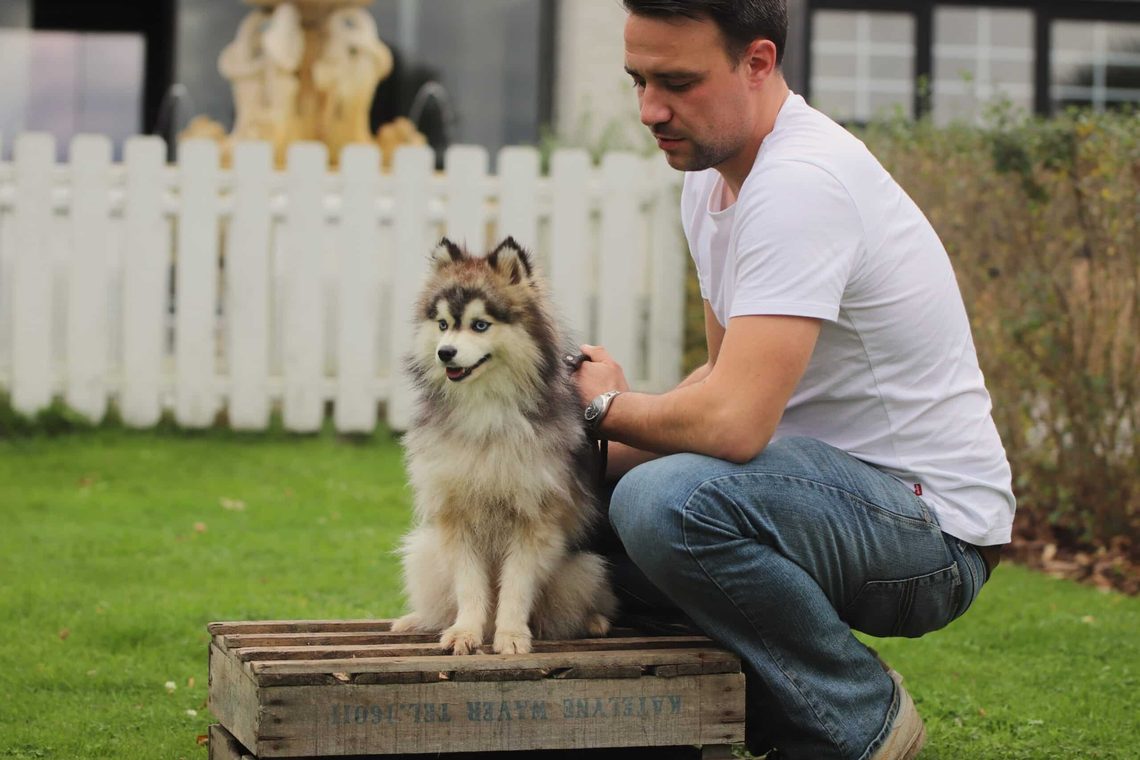
- Belgian breeder since 1990
- DNA-tested parents
Available now
Available Pomsky puppies for sale
Click ‘Puppy alert’ to stay up to date on new Pomsky litters.
Our usual process
Buying a Pomsky puppy from Woefkesranch
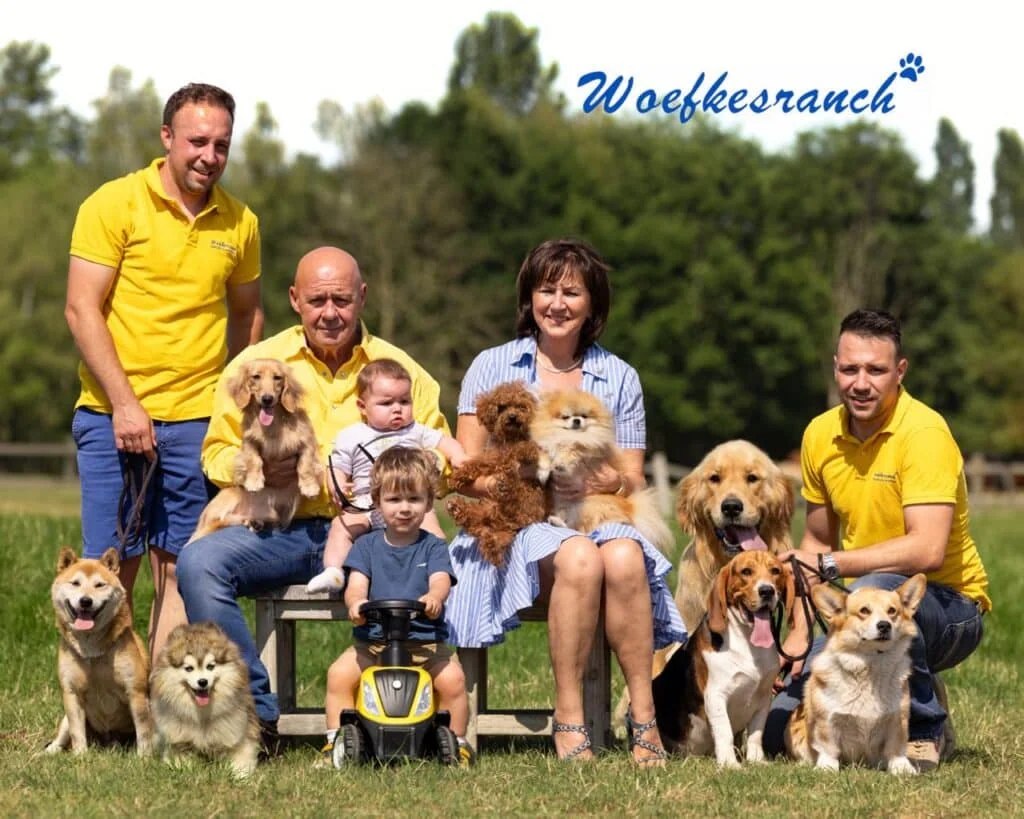
How it works:
- Meet the puppies (optional). Make an appointment to see the puppies with their mother, and to work out together which puppy suits your family.
- Reserve your puppy (optional). You can reserve online (24/7) or by phone on +32 (0)15 75 59 42. After reserving, you receive photos on request. If a puppy is already 8 weeks old, you can also take it home at your visit.
- Collection from us or home delivery. You can collect your puppy from 8 weeks old. It leaves microchipped, vaccinated, dewormed and with its European passport, and we register it in your name in DogID together. If you have no transport, someone from Woefkesranch brings your puppy to your home, within 250 km of our ranch in Putte (including the Netherlands, France, Luxembourg and Germany).
- 1-year guarantee. Every puppy has a 1-year guarantee on hereditary conditions and hidden congenital defects. We remind you about the first booster vaccination and deworming.
- Lifelong support. We remain available by phone or WhatsApp, also for training tips and health questions. For urgent matters we can be reached 24/7.

Written and reviewed by Marleen Dyck, co-founder of Woefkesranch
Character
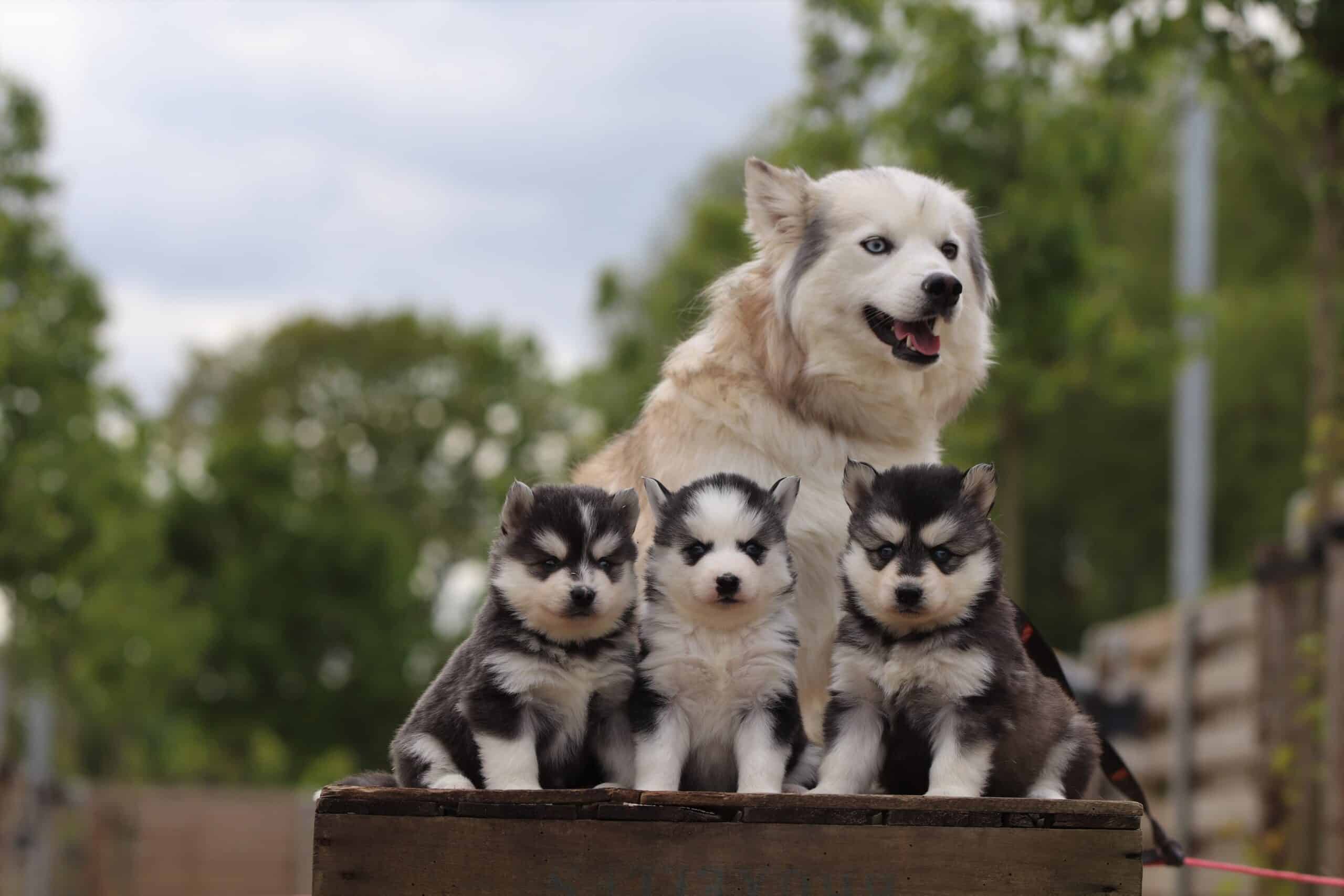
An energetic small dog with a husky’s looks and eyes
Lively, playful and closely attached to its own people. It is a cross between a Pomeranian and a Siberian Husky, so it carries a husky’s markings and coat in a dog of around 14 kg. It learns fast and it wants something to do every day.
What to expect
Energetic
Wants its walk and a game every single day.
Loyal
Bonds hard with its own household.
Quick to learn
Picks commands up fast, and tests the rules.
Alert
Notices everything, and tells you about it.
Height*
~33 cm
Weight*
~14 kg
Life expectancy
~14 years
Origin
United States, 2010s
*The sizes above are guide values for this breed. Woefkesranch aims for them, but the health of the dogs always comes first.
Breed summary
You will find the Pomsky is a companion dog with a working breed behind it: energetic, clever and very social with its own family. It came out of crossing a Pomeranian with a Siberian Husky, which gives the compact size of the one and the markings, the thick double coat and often the blue eyes of the other. A walk of about forty minutes a day keeps it content, and the mind needs as much attention as the legs. Because both parent breeds are behind it, both sets of health checks apply, which is why we test for hips, knees and eyes. Read on to see what this breed asks of you.
In five points
- The Pomsky is a cross between a Pomeranian and a Siberian Husky, which puts a husky’s markings in a dog of around 14 kg.
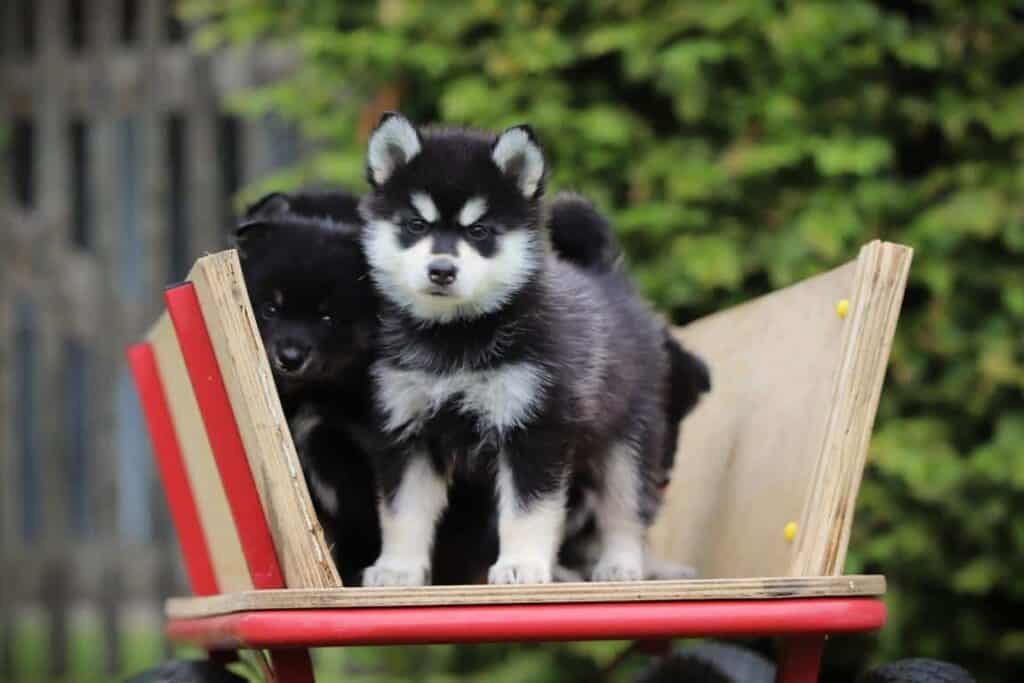
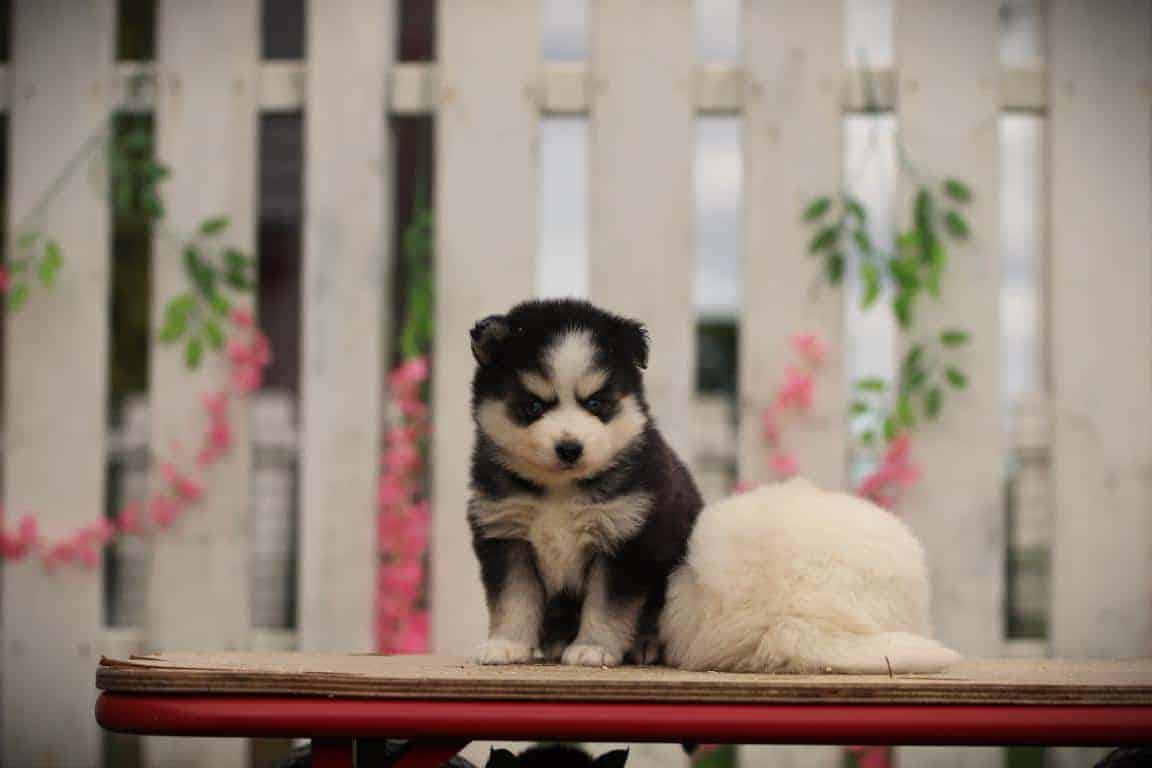
- The coat is thick, soft and double-layered, in white, black, grey, brown, cream or reddish shades, often with the facial mask of a husky.
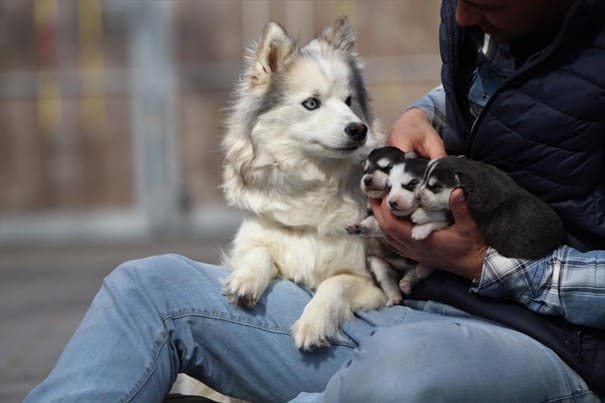
- Eye colour runs from dark brown to bright blue, and two differently coloured eyes are possible, which comes from the husky side.
- A walk of about forty minutes a day suits it, and it will take more without difficulty.
- Both parent breeds are health tested for hips, knees and eyes, and the breed lives ~14 years.
History and Origin
The Pomsky is a recent cross. It first appeared in the early 2000s, from a Pomeranian and a Siberian Husky, and it was bred deliberately rather than by accident.
Both parent breeds are old. The Pomeranian is a spitz bred down in size in Germany from larger spitz dogs, and the Siberian Husky is a sled dog from north-eastern Siberia, so the cross puts a working northern breed together with a companion bred from the same root stock.
Physical characteristics, eye colour and grooming
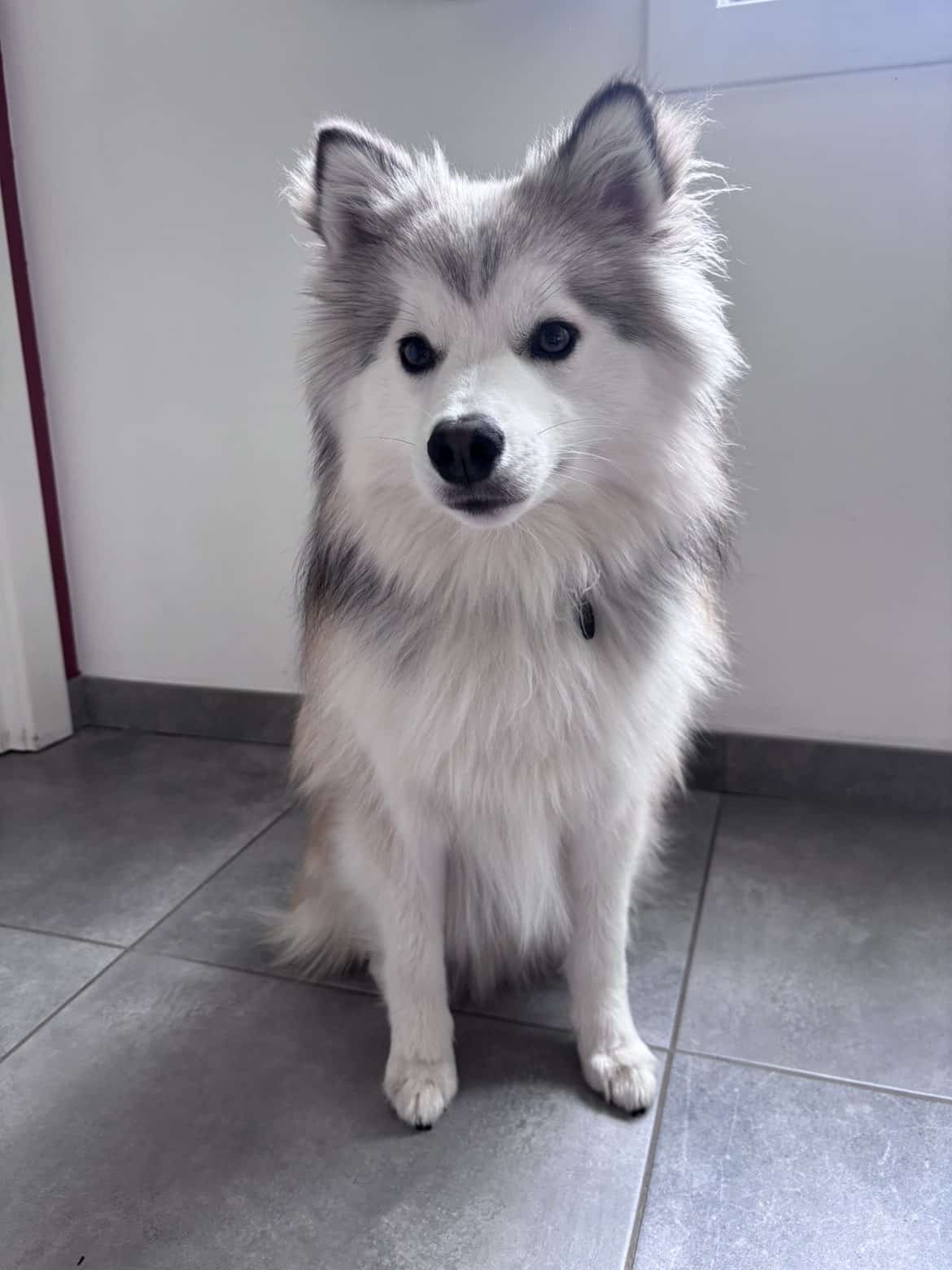
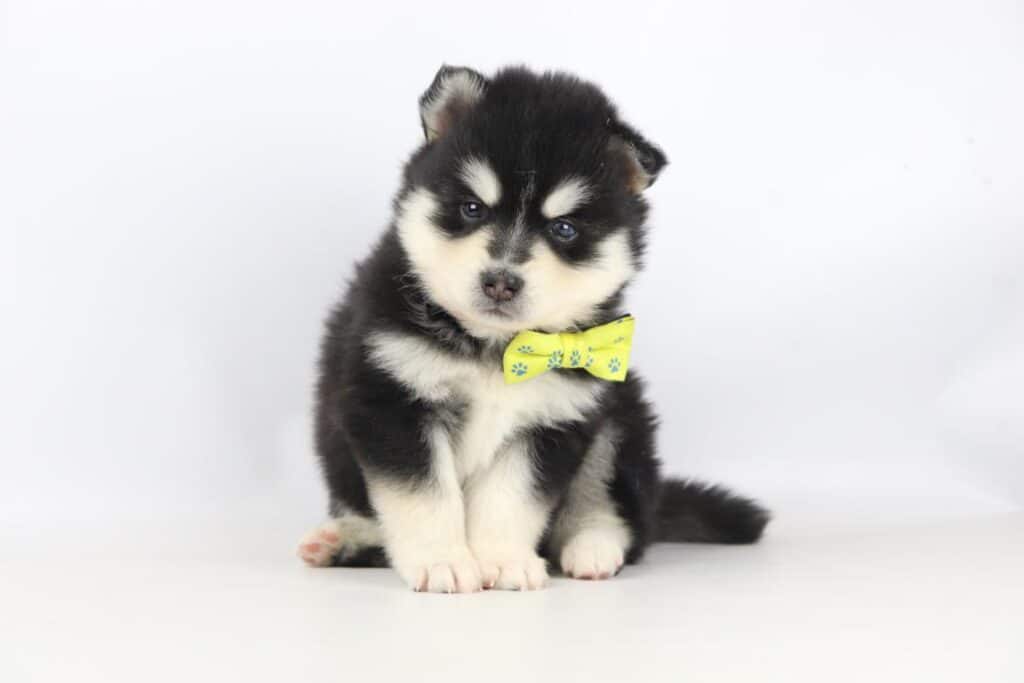
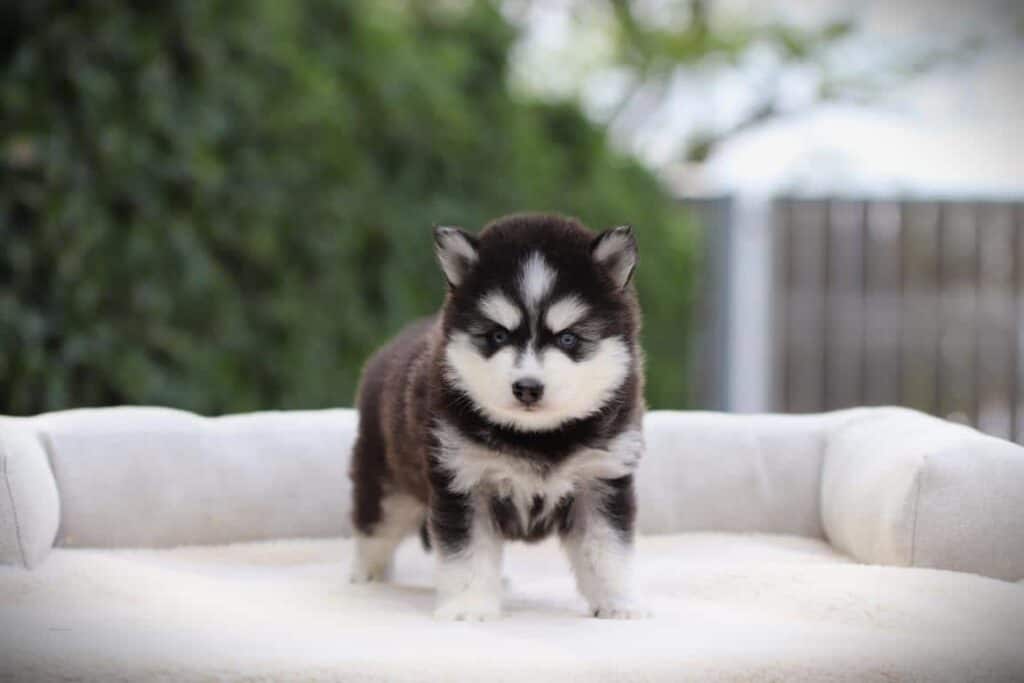
The Pomsky is compact and well balanced, with the outline of a small Siberian Husky and something of the Pomeranian’s finer build. Because it is a cross, the details vary from dog to dog: shoulder height sits around 33 cm and weight around 14 kg. The coat is thick, soft and silky, a dense undercoat beneath a protective topcoat, and it comes in white, black, grey, brown, cream or reddish shades, often combined with the facial mask of a husky.
The head is in proportion, with small triangular ears that stand upright and almond-shaped eyes. Eye colour runs from dark brown to bright blue, and two differently coloured eyes occur as well, which is a legacy of the Siberian Husky. The tail is curled and usually carried over the back.
Comparison of the Pomsky, the Pomeranian and the Maltese
| What differs | Pomsky | 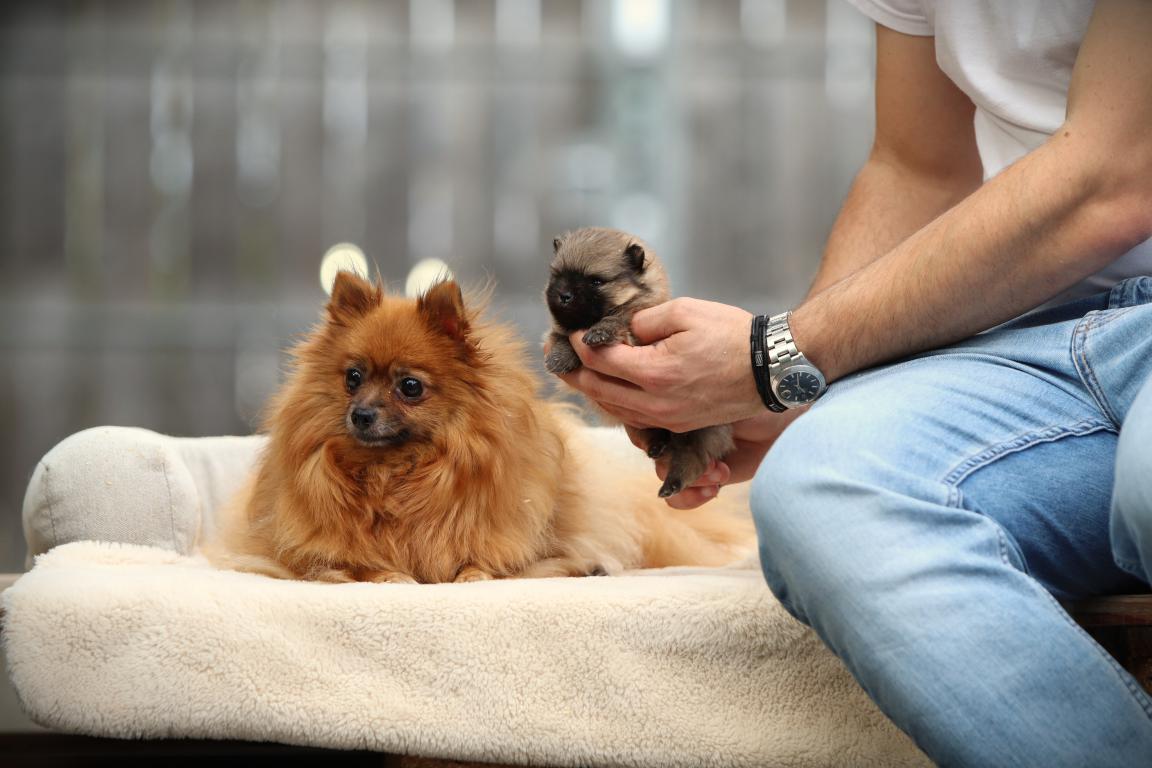 Pomeranian Pomeranian | 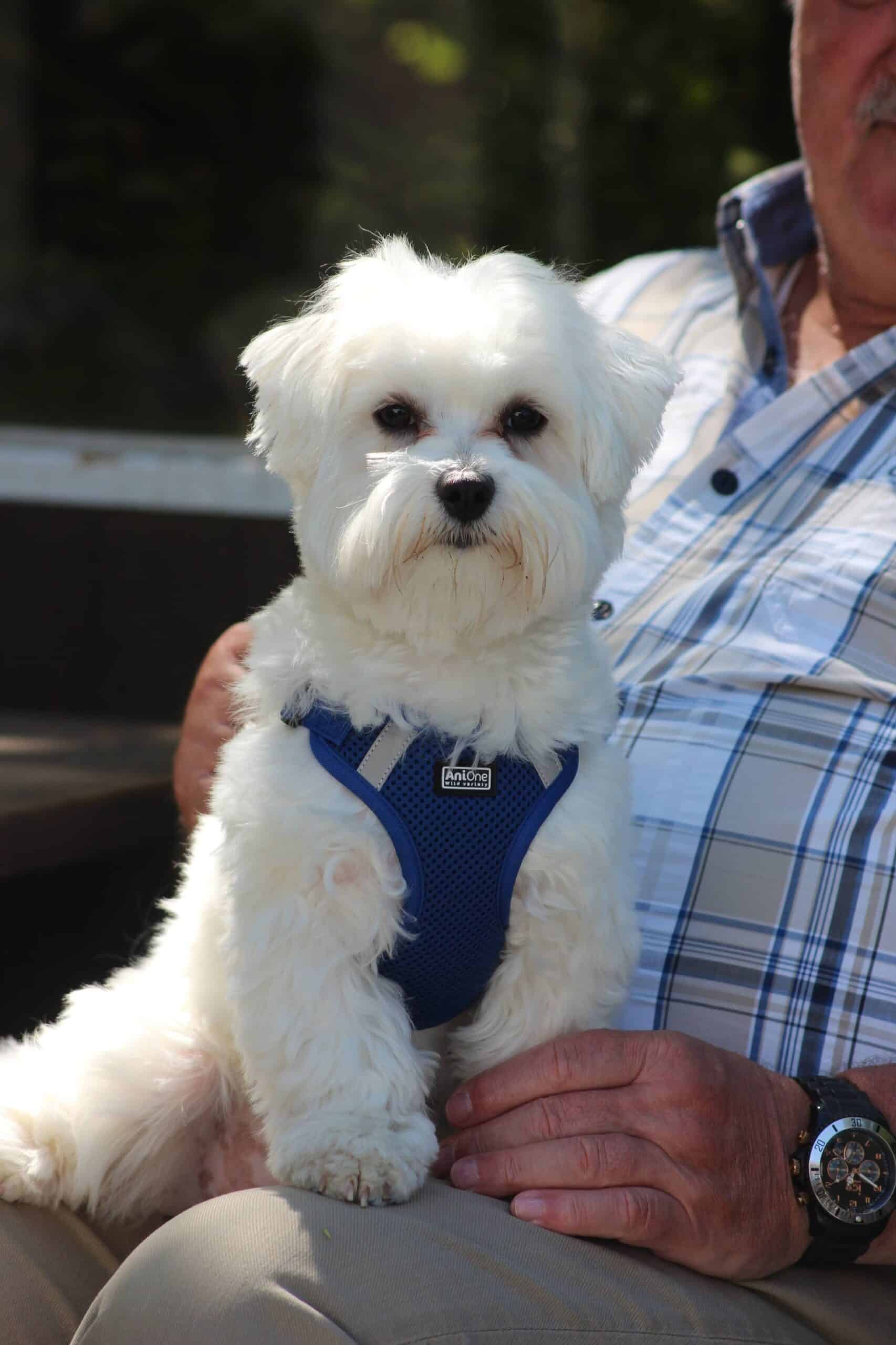 Maltese Maltese |
|---|---|---|---|
| Origin | A recent cross of the Pomeranian and the Siberian Husky, bred as a companion dog with the look of a husky | A purebred from Germany, a spitz bred down in size from larger spitz dogs | A purebred from Malta and Italy, a companion dog for three thousand years |
| Size | Medium-sized: ~33 cm and ~14 kg | Small: ~21 cm and ~3 kg | Small: ~22.5 cm and ~3.5 kg |
| Coat and grooming | Thick and double, with an undercoat that moults, often with a husky’s mask. Brushing two to three times a week, more often during the moult | Thick and double, with an undercoat that moults. Brushing two to three times a week, more often during the moult | Long, white and silky, with no undercoat. Combing weekly and the groomer once or twice a year |
| Character and exercise | Happiest when the family heads out and it can come along. Needs about forty minutes of walking a day | Happiest when it can join in and learn something. Half an hour of walking a day is enough | Happiest in the middle of the family. A short daily walk is enough |
All three are companion dogs that are strongly attached to their own family. They suit an apartment, as long as they get their daily walk.
Personality and Temperament
A Pomsky is energetic and playful, social with everyone in its household and quick to form a close bond with them. It is intelligent and willing, which makes training straightforward, although the Pomeranian’s stubbornness surfaces now and then when the dog decides it knows better.
It is alert and it will tell you when someone reaches the door, and it can be reserved with strangers at first. Socialised properly from a young age it grows into a friendly, settled dog. The energy is real, so it needs the walk, the games and something to think about daily.
Health and Nutrition
A crossbreed draws on two gene pools instead of one, which is the reason for the cross. The genetic distance between mother and father stays wide, which is what avoids inbreeding, and the chance of an inherited defect drops even though the list of possible ones gets longer.
The sensitivities of both parent breeds come along, so both are tested for. A Siberian Husky is checked on hips and on eyes, for cataracts and glaucoma, and a Pomeranian mainly on the knees, for patellar luxation. Where both parents are Pomskies, all four checks are taken into account.
A dog with hip dysplasia or patellar luxation is left out of our breeding. That does not make a defect impossible in a puppy, but it makes it unlikely. The rest depends on how the dog grows up: its food, its exercise, the age at which it is neutered. The breed lives ~14 years.
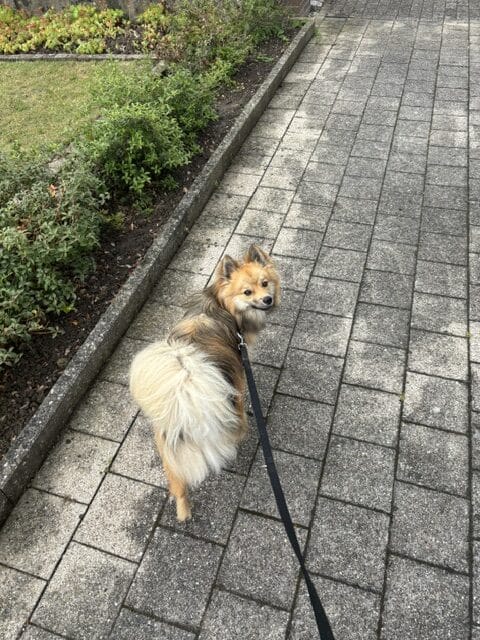
Training and Exercise
Start early and stay consistent. A Pomsky works out what is allowed within days and then keeps testing it, so the rules have to mean the same thing every time. Reward what you want the moment it happens, with a treat, praise or a game, and be just as clear about what you do not want.
Socialisation matters here because the breed is naturally cautious with strangers. In the first four months, introduce the puppy to different people, animals, sounds and environments, rewarding the calm reaction each time. Controlled playdates and a puppy class both help, and so does knowing when to step in and set a boundary.
Keep the sessions short and frequent. Ten or fifteen minutes a few times a day works better than one long session. Sit, stay, come and leave it are the commands to have in place early, and your approval or disapproval should be obvious to the dog either way.
Choosing and caring for your Pomsky
Is this the right breed for you?
A Pomsky suits a household that is out and about and wants the dog along. It is small enough for an apartment and content with a garden, as long as the walk happens. The minimum age to take a puppy home in Belgium is eight weeks, and a puppy collected then has the better start on socialisation and training.
Essential daily care
Caring for a Pomsky means committing to a daily routine that addresses their grooming, feeding, exercise and health needs.
For optimal daily care, focus on these key points:
Exercise
About forty minutes of walking a day keeps a Pomsky happy, and it can handle a longer hike at the weekend without any trouble.
Mind
It values mental work as much as physical. A short training session, a puzzle toy or simply a different route is often enough.
Socialisation
In the first four months, introduce the puppy to people, animals, sounds and places, and reward the calm reaction each time.
Boundaries
It works out what is allowed within days and tests it for months, so the rules have to mean the same thing every time.
Regular veterinary visits are essential to monitor health, contributing to a longer lifespan for your Pomsky. If you are considering getting a puppy, it is important to recognize a good breeder.
Recognised family business since 1990, now in its second generation
We are a recognized breeder of Pomsky puppies in Belgium. Our ranch is in Putte (near Mechelen), between Brussels and Antwerp, about 40 kilometers from Brussels, 30 kilometers from Antwerp and 80 kilometers from Ghent. Our puppies are socialized on the ranch through contact with our caretakers and with other dogs and puppies. Woefkesranch has been a family business since 1990 and is now in its second generation. Every puppy is born in our own kennel under permanent supervision, with no imports and no middlemen. Families are guided before the purchase and are welcome back with their questions long afterwards.
Delivery to your door in and around Brussels, Cologne, Amsterdam, Rotterdam, Düsseldorf, Essen, The Hague…
If you have no transport, someone from Woefkesranch brings your puppy to your home, up to 250 km from Putte. Approximately: Hasselt 60 km, Charleroi 80 km, Mons 100 km, Liège 110 km, Bruges 120 km, Rotterdam 120 km, The Hague 150 km, Düsseldorf 180 km, Amsterdam 190 km, Cologne 190 km, Essen 220 km.
Frequently Asked Questions
How long does a Pomsky live?
The breed lives ~14 years, and a crossbreed benefits from the wider gene pool behind it. Diet, exercise and the quality of care decide most of the rest.
Is a Pomsky good with children?
Friendly and playful, and good with children when it has been socialised properly. It likes being part of what the family is doing, which is most of what makes a dog easy with children in the first place.
Can a Pomsky live in an apartment?
Yes. At around 33 cm it fits a smaller home comfortably, as long as it gets its daily walk and something to occupy its mind.
How much exercise does a Pomsky need?
About forty minutes of walking a day is usually enough, and it can manage considerably more. Energy varies between individuals: some are content with a steady routine, others want the long weekend hike. Consistency matters more than intensity.
What should a Pomsky eat?
Good quality food rich in animal protein, matched to the dog’s age and energy level. Keep feeding what the puppy was used to at the breeder for the first weeks, because changing the food and the home at once is what upsets a stomach.
Is a Pomsky healthy?
The breeding draws on two gene pools, which keeps the genetic distance between the parents wide and the risk of an inherited defect low. Both sides are tested: hips and eyes from the husky, knees from the Pomeranian.
Come and see
Make an appointment
Do you want to visit our puppies? You can also make an appointment.
- 100% Belgian puppies
- Professional statutory warranty
- 24/7 service after sale
- Puppies have all necessary vaccines
- Puppies are dewormed multiple times
- Chipped and with Belgian/European passport
- DNA-tested parents