Solving bone problems in dogs is easy with Silicon for dogs. Read more about this natural product.
Joint wear is caused by a degeneration of the joint cartilage. The balance between the building up and breaking down of the cartilage is disturbed. This is a result of a combination of joint damage and normal wear and tear. Sometimes the cartilage wear is so severe that the bone is also affected. The older a person or animal gets, the greater the chance of joint wear. The elasticity of the cartilage is essential because it protects the bones against the slight shocks caused by your movements and facilitates the movement of one bone (end) over the other. The onset of osteoarthritis can be attributed to aging, recurring injury, and nutrition.
To continuously renew cartilage, one element is essential: silicon. The older the person and/or animal gets, the more difficult it becomes to absorb silicon in the body, and what adds to this is that modern nutrition contains little absorbable silicon. Silicon is essential for the production of collagen fibers that form the cartilage. A lack of silicon also means a lack of collagen, which is precisely the adhesive that must hold the molecules of our cartilage together.
The formation of more connective tissue (more collagen) results in stronger ligaments, capsules, and tendons, as well as stronger bones (greater bone density). Moreover, connective tissue protein is essential for the flexibility of the bone.
The mineral Silicon
Silicon (chemical symbol: Si; English term: silicon) is the most common element on earth after oxygen. The earth’s crust consists of 27.7% silicon. This is significantly more than carbon, which makes up only 0.0018% of the earth’s crust. The most common silicon compound is SiO2 (silicon dioxide or silicic acid). The salts of silicic acid are silicates. Silicates hydrolyze in an aqueous environment to oligomeric forms of silicic acid.
Only the small molecular forms of silicic acid are biologically absorbable. This applies to plants, humans, and animals. Especially mono-, di-, and tri-silicic acid is biologically well absorbable. In the continuation of this informative piece about silicon, silicon refers to the combination of mono-, di-, and tri-silicic acid.
Plankton as an example
A convincing example of the importance of silicon for the plant kingdom is plankton. For example, 40% of phytoplankton depends on oligomeric silicic acid. The cells need an active silicon metabolism to stay alive. And without silicon, a large part of the phytoplankton would be lost, causing the entire food chain in the ocean to be lost.
Phytoplankton is also responsible for 40% of the oxygen production on earth, so the conclusion must be that without silicon, no life on earth is possible.
Silicon and the body
The first signs of a silicon deficiency are usually found in the skin, hair (read coat in horses), and nails (read hooves in horses). The skin and hair lose their strength and elasticity, and nails become crumbly and brittle. These symptoms are common in older people because the silicon concentration in the blood decreases as the years increase.
The supplementation of silicon-containing food counteracts this effect, and her skin and nails will visibly improve.
A more serious phenomenon that is also mainly the result of a silicon deficiency and that also accompanies aging is osteoarthritis.
Osteoarthritis and joints
Joint wear is caused by a degeneration of the joint cartilage. The balance between the building up and breaking down of the cartilage is disturbed.
This is a result of a combination of joint damage and normal wear and tear. Sometimes the cartilage wear is so severe that the bone is also affected. The older a person or animal gets, the greater the chance of joint wear.
Stiff and rigid
Older people and animals are often stiff and rigid in the joints, especially when getting up. One of the causes is that the soft cartilage located at the end of a bone is affected.
Cartilage is the soft elastic layer in the joints that can be found, for example, when eating chicken. It is a rubbery, somewhat translucent substance.
The body is constantly in motion. The musculoskeletal system and thus the joint function largely determine the freedom of movement. Problems with the musculoskeletal system can severely limit this functioning.
The elasticity
The elasticity of the cartilage is essential because it protects the bones against the slight shocks caused by your movements and facilitates the movement of one bone (end) over the other.
Cartilage is a unique tissue in the body because it contains no blood vessels and nerves. As a result, the supply of nutrients is often insufficient.
When cartilage is placed under a microscope, it resembles a sponge. But when the joint is at rest, the cartilage is filled with fluid. When the joint experiences a shock or is subjected to pressure, the fluid disappears from the cartilage, just as if a sponge filled with water is squeezed.
In a healthy process, the fluid returns to the cartilage when the pressure decreases, but in chronic overload, there can be a strong production of free radicals. These free radicals oxidize the large cartilage molecules in the joint fluid, reducing the sponge effect; the fluid disappears little by little.
The spongy tissue becomes dry and brittle and loses its elasticity. The recurring shocks and frictions increasingly damage the dry cartilage, and over time it disappears. The bone ends are then no longer protected, and the bone itself is affected and begins to deform.
Pain
The result is pain, which can cause less and less physical activity to be performed, and that physical activity is precisely necessary to keep the joints flexible.
This creates a downward spiral of degeneration (aging and wear).
Other symptoms or phenomena may occur, such as inflammation, deformities, etc.
The usual medical approach is to prescribe various painkillers and/or anti-inflammatories, and as a result of various side effects of these drugs, a kind of roller coaster of medications arises. Good for the pharmacy, but not good for humans and/or animals.
The common medical opinion is that osteoarthritis is irreversible (thus incurable) and that all that can be done is to slow down its development.
That osteoarthritis is irreversible is a misconception!
The main component of cartilage is water. The rest consists of the connective tissue fiber collagen (adhesive) and glycoproteins (sugar proteins) that are mainly composed of polysaccharides (multiple sugars).
These are large molecules composed of sugars and proteins that form the tissue in which the fluid circulates.
Cartilage is formed by the chondrocytes (cartilage cells) that must ensure that there is enough cartilage present and that must purify the cartilage of collagen and glycoproteins that have become too old.
The onset of osteoarthritis
The onset of osteoarthritis can be attributed to aging, recurring injury, and nutrition.
To continuously renew cartilage, one element is essential: silicon (silica).
The older the person and/or animal gets, the more difficult it becomes to absorb silicon in the body, and what adds to this is that modern nutrition contains little absorbable silicon.
This is because, as the person and/or animal gets older, less of a certain acid is produced, which is necessary to absorb silicon in the body. This results in a silicon deficiency.
Production of collagen fibers
However, silicon is essential for the production of collagen fibers that form the cartilage. A lack of silicon also means a lack of collagen, which is precisely the adhesive that must hold the molecules of our cartilage together.
Silicon stimulates the production of new bone cells and slows down bone disintegration. Moreover, silicon boosts the calcium and vitamin D metabolism.
This also results in fractures healing better and faster.
The formation of more connective tissue (more collagen) results in stronger ligaments, capsules, and tendons, as well as stronger bones (greater bone density). Moreover, connective tissue protein is essential for the flexibility of the bone.
Bone decay
Osteoporosis is a bone disease. In osteoporosis, the amount of bone tissue and usually also its cohesion is reduced. So much so that even with a slight load, skeletal deformation occurs. An important factor is the maximum bone mass. This determines whether someone will experience osteoporosis fractures in old age. This bone mass is reached between the ages of twenty and thirty. After reaching the maximum bone mass, the bone mass remains stable for a few years, after which a period of bone loss begins. Most of the prevention of osteoporosis should therefore take place in the first thirty years of life (in horses the first 7 years).
In addition to genetic (inherited) factors, bone mass is determined by physical activity and nutrition. In addition to calcium, phosphorus, magnesium, boron, manganese, zinc, copper, and silicon also play an important role. Sufficient calcium in the diet is very important.
For the absorption of calcium, silicon plays a major role. Silicon functions as a transport medium in the body, allowing calcium to be better absorbed and penetrate throughout the body. A similar effect is seen when administering a silicon-containing foliar fertilizer, for example, in apple cultivation. The effect of this is that more calcium ends up in the apple, with all the positive consequences.
The relationship between silicic acid and other minerals
Silicon interacts with various other minerals, such as calcium, magnesium, boron, phosphate, zinc, and copper. Almost all data come from animal studies.
Emmerick et al. (1990) showed that the administration of extra silicon led to an increase in copper and copper-related effects.
Najda et al. (1992) saw similar results regarding copper. They also saw a higher iron concentration due to the administration of extra silicon, while the zinc content decreased. A year later, they found that the administration of extra meta-silicate led to a decrease in magnesium content and an increase in calcium levels in the serum.
In an article by Calcomme et al. (1997), it appears that the administration of biologically absorbable (stabilized) silicic acid leads to a moderate increase in phosphorus (P) and magnesium (Mg). More importantly, the increase in calcium: this was proportional to the increased silicon concentration in the serum.
Seaborn and Nielsen showed in rats that silicon-deficient nutrition led to a decrease in minerals in bone tissue, such as calcium, copper, zinc, potassium, and phosphorus.
McCrady (2003) showed in rats that silicon supplementation increases the calcium, phosphorus, and magnesium concentrations in the vertebrae and skull.
Silicon and Alzheimer
High silicon supplementation can reduce the risk of developing Alzheimer’s disease (American Journal of Clinical Nutrition). Although silicon is not known to have a direct effect on brain function, it appears that silicon binds aluminum and ensures that aluminum is excreted through the urine. Aluminum is a very toxic metal that plays a role in the development of Alzheimer’s disease and other forms of dementia. Silicon prevents the accumulation of aluminum.
Interesting is the participation of over 7500 French women aged 75 and older in a study. At the beginning of this study, an estimate was made of the amount of silicon dioxide consumed per day. The amount to which each participant in the study was exposed daily through drinking water. Women who consumed less silicon-containing water performed worse. This in the context of their cognitive function. All this compared to women who consumed a higher dose of the drinking water.
A subgroup of the population was followed for a period of 7 years. It turned out that the intake of the amount of silicon determined the degree of risk of developing Alzheimer’s disease.
Safety aspects
From 2005 to 2009, the European Food & Safety Authority (EFSA) looked at the safety, toxicity, and permissible amounts of silicon in human applications. This study made it clear that silicon in the form of silicates and silicic acid can be fully assessed as safe. It was also checked whether silicon appeared on any doping list. This was not the case for humans. Therefore, it can be assumed that this also applies to horses.
Silicon in the environment
Silicon is, as mentioned above, the most common element on earth after oxygen. It is an important basic substance for sand. Silicon dioxide, present in the quartz crystals of sand, cannot be consumed by horses, it is not bio-absorbable, making it useless as a food.
Plants
However, plants use silicon to provide strength in their cell walls. Through these plants and their normal diet, horses receive small amounts of this essential mineral, but it seems that in the feed that comes to the horse through commercial channels, there is less and less of this bio-absorbable silicon available.
Despite its presence in nature, surprisingly little is known about the nutritional importance of silicon in the diet for mammals. That said, the American Institute of Nutrition recently reformulated their published formulas for conducting experiments with rodents with pure diets by deciding to add silicon as a necessary nutrient.
This change was the result of research that showed that silicon led to interaction with other nutrients with all the positive possible consequences.
Silicon in bone and connective tissue
Most people think that a bone is primarily formed by the minerals calcium and phosphorus. Of course, there are many more components that are part of the bone than just these two elements. To begin with, the bone is constantly in motion in the sense that old or damaged parts are replaced by new healthy parts.
Silicon plays a role in the formation of new bone and the calcification process. Interestingly, in the early stage of calcification, the amounts of silicon and calcium are low, but as the mineralization process progresses, these increase. However, as the bone gets older and reaches full maturity, the concentration of silicon decreases, while the amount of calcium remains the same.
The exact role has yet to be determined.
However, it seems that silicon is especially important in the young, still developing horse, where the skeleton is still subject to rapid change. This theory, in which silicon is involved in an early stage of bone formation, is supported by studies conducted on chickens. The chickens in those studies were subjected to a silicon-deficient diet. This led to an abnormal bone structure.
While the role of silicon in the mineralization process of bones is emphasized, silicon also plays an important role in the formation of the collagen matrix of bones and blood vessels. The formation of this matrix is necessary to prevent the connective tissue from becoming brittle and susceptible to damage.
When there is a lack of silicon in the diet, the formation of the matrix is limited; the consequences of this are even greater than those resulting from the absence of silicon in the mineralization process. In the connective tissue structures of bones and blood vessels, it appears that the formation and growth of the bone supported by silicon is mainly a result of the increase in the concentration of collagen.
The formation of glycosaminoglycans, the main polymeric molecule of the bone matrix, also requires silicon. Again, when chickens were fed a silicon-deficient diet, it was found that the amount of collagen in the bones was reduced. The amount of cartilage in the joints was also reduced compared to the chickens that received extra silicon through the feed.
At the molecular level, it has been shown that silicon is present in the mucopolysaccharides and is partly responsible for the formation of cartilage in the joints and connective tissue.
Thus, it is an integral part of the mucopolysaccharide protein complex, and the formation of collagen and connective tissue is stimulated by silicon.
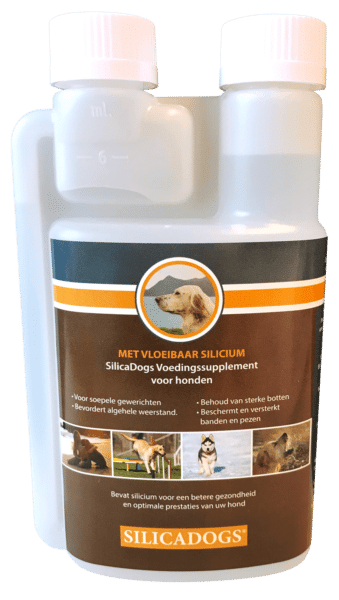
Bone problems in dogs: silicon
SilicaDogs is a complementary animal feed with silicon. It is good for flexible joints and strong bones. It also ensures the overall condition of your dog.
Silicon ensures that your dog’s balance improves. This mineral is of great importance for your dog’s health. Your dog also remains in good condition naturally.
