You also want your dog to look beautiful and healthy. Read this blog for numerous tips and tricks on grooming your dog’s coat.
Washing
Material & Product
Shampoo
Characteristics of a good shampoo.
- Easy to rinse out
- Should not impede combing
- Should not cause static electricity
- Should make the coat lively and shiny
- Should be skin-friendly.
Types of shampoos
- Detangling shampoo
- Antiparasitic shampoo
- Anti-dandruff shampoo (for example: Sebazol available at pharmacies)
- Anti-scabies shampoo or tar shampoo
- Organic shampoo
- Conditioning shampoo or oil-based shampoo
- Restorative shampoo, deeply nourishing shampoo
- Itch-soothing shampoo
- Hydrating, mild, hypoallergenic shampoo and soap-free shampoo.
- For example, Dermcanis is available at the pharmacy
- Color-enhancing shampoo for white, brown, black, apricot and gray coats
- Medical shampoo, possibly prescribed by a veterinarian
- Ontolir: to be used after oil treatment.
- Puppy shampoo
- Shampoo for dogs with sticky coats: opens the pores faster
- Closes + mildly disinfecting
- Universal shampoo
- Volume-enhancing shampoo
Not all coats are the same.
One skin reacts differently to a particular product than another. A coat can be in a certain condition, meaning it may need a different shampoo than usual.
Be sparing with shampoo.
- You’d sometimes be surprised how much you can dilute some shampoos; sometimes 1 cup (coffee-machine cup) in 5 liters is enough! Be consciously aware of how much of the given shampoo you need.
- Using the familiar pump dispensers.
Functions of washing
- Removal of dirt. Cleans without excessive degreasing.
- Removal of flakes
Conditioner
Properties of the conditioner:
- Closes the hair cuticles.
- Adds shine
- Adds suppleness
- Removes static electricity
- Makes hair easy to comb and elastic
- Balances pH levels
- Prevents tangles
- Provides a protective layer
Conditioners for different purposes.
- Adds volume
- Especially nourishing to prevent the ends from drying out.
- Color conditioner, provides a deep, long-lasting but not permanent effect.
- You can use it, among other things, to conceal white hairs.
Use of balm or conditioner is suitable for a wide range of purposes
- For dogs with many tangles.
- For long-haired dogs
- For well-maintained dogs that are washed very regularly.
- For dogs that naturally have a lot of sebum (e.g., Labradors) and that, for various reasons, are washed regularly or often.
Additional items needed for dog coat care:
- Towels
- Quick dryer/waterblazer
- Standing warm air dryer
- Brushes for dogs
- Dog combs
- Bath
- Sponge, e.g. a dishwashing sponge cut in half, of which you of course use the soft side.
How to prepare
The curly coat is treated layer by layer with a curved pin brush:
1. The curly coat is brushed layer by layer
Depending on the condition of the coat, the coat is prepared.
For thick or unkempt curly coats, it’s best to use:
The water blower. This opens the coat well. It’s easy and time-saving.
A detangling universal brush (fewer teeth, pulls less on the skin)
Mat comb or mat breaker: if necessary.
Then the standard universal brush
For normally groomed coats.
Use the standard universal brush
For curly coats that are perfectly maintained by the owner or where you prefer to preserve the hair.
curved pin brush, but then a very soft type (Slicker)
for very long hair, use the straight pin brush.
2. To check whether the coat is truly tangle-free:
After combing with a coarse to medium comb
Check down to the skin with the standing dryer and brush or comb out the last bits.
Other coats:
Other coats will be treated with the appropriate products after determining the coat type; don’t forget to take into account whether the dog is in its shedding period.
During shedding you try to brush out the hairs that may be removed. (the undercoat, the topcoat?)
Why prepare?
- Flakes come off easily when brushing; if they come off during or after blow-drying they will be difficult to remove.
- The inside of the tangle is difficult for the shampoo to reach, so it was not cleaned or was only partially cleaned; if the shampoo does reach the inside of the tangle, there is a good chance that soap residue will remain during rinsing.
- If the dog wasn’t perfectly brushed during preparation, you have to spend a great deal of time brushing while blow-drying. This causes the coat to dry in curls, so a perfect finish is impossible unless you continually re-moisten the curled coat, making the whole process very time-consuming.
- With shedding dogs, huge amounts of hair fly around while blow-drying, making this an extremely unpleasant job — for example, with a Newfoundland it may require an extra brushing afterward!
Protect the inner ear
If no oiled cotton or other means (see tip) are used, there’s a good chance that water will enter the ears, resulting in an ear infection.
Apply oiled cotton in the ears.
Tear off long strips, preferably slightly thicker than the dog’s ear opening. Gently insert them into the ear and remove any excess length.
Be careful not to use pieces that are too small—a lost fragment can lead to an ear infection.
Why oiled cotton and not regular cotton wool?
To avoid misunderstandings, oiled cotton does not feel greasy or oily, so the dog won’t get smeared when inserting or removing the cotton.
Tip:
Only for experienced dog groomers to protect the drooping inner ear and only to be used for dogs that remain calm during soaping and rinsing.
In general, you can protect drooping ears from water by making a twisting motion at the base of the ear.
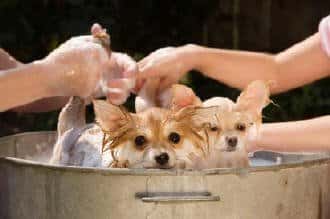
Soaping
Temperature:
Use a body part other than your hands to determine the temperature, e.g. forearm
Wet the coat?
You can also use the diluted shampoo immediately, making pre-wetting unnecessary. Lightly spray the dog.
For dogs that panic at the sprayer, reduce the water pressure by setting the sprayer to the appropriate setting.
Shampoo distribution:
There are several ways to apply the shampoo. Very few dog groomers use pure shampoo on a damp coat.
Reason: using highly concentrated shampoo can irritate the skin and the shampoo consumption will be much higher.
Different ways to dilute shampoo in large or small quantities:
- Pour a thin layer of shampoo into the bottom of a measuring cup and dilute it halfway with water. The advantage of a measuring cup is that you can dip parts of the dog’s body (floppy ear, paw, tail) into it.
- We dilute the shampoo in a (dish soap) bottle, so you can distribute the right amount in the right place. If you know you’ll need a lot of shampoo for one dog, dilute the shampoo in a container of, for example, 5 liters.
Conclusion: using the well-known (dish soap) bottle offers the most advantages, but the use of the measuring cup still proves its usefulness.
How to massage shampoo in?
When shampooing we massage:
- The shorter coats with a gentle rotating motion.
- The longer parts are kneaded with pinching movements.
Important: washing a long-haired dog with rotary movements can lead to matting
Use of a small sponge:
- A smooth-haired head (e.g. German Shepherd)
- inside of a hanging or upright ear.
Rinsing
We ensure that no water gets into the eyes, nose and ears.
For long ears we turn the outer part outward so they are safe and easily accessible.
Make sure no soap residue gets into the eyes!
Place your hand over the nose.
Hold slightly downward while making a gentle up-and-down motion at the same time.
Rinse thoroughly:
When rinsing the body we pay special attention to: the armpits, the inside of the legs and the belly.
Missed a spot? It can cause itching and skin irritation.
For heavily soiled dogs two or three washes may be necessary.
After the first wash it may be useful to give the most soiled areas, such as legs, head and tail, a second wash.
For a second wash choose a shampoo that has more conditioning properties suited to the specific condition of the coat or skin.
Applying balm, lotion or other products
Balm can be used in different ways.
- General use in the grooming salon: after washing the dog, rub the cream (pure or diluted) over the entire dog and leave it on for a few minutes, then rinse thoroughly with water.
- Curly coats or coats that need to look very voluminous or fluffy for shows: apply a diluted conditioner to the dog, do not rinse, but begin drying.
- Downside: the dog dries more slowly.
A few frequently asked questions from owners
I have a puppy (short-haired), I’m not planning to wash him, so I don’t need to get him used to bathing!
There are indeed ways to keep short-haired dogs clean.
Nevertheless, it is advisable to accustom a dog to bathing from a young age.
Reason:
- Many dogs roll in a carcass or in manure or end up in a muddy ditch, …
- It is also possible that, during a dog’s life, a medical reason will arise that makes washing necessary at the veterinarian’s request.
Wolves and wild canids are not washed either — why would I wash my dog? Or weren’t dogs washed in the past?
Firstly, long-haired dogs do not occur in the wild because they would not survive.
People who come into contact with wild dogs know that they smell strongly and are dirty, so they are not suitable to live in an average home.
There are animals that do a great deal of self-hygiene, think of cats.
Hedgehogs are the opposite; they do almost nothing for their hygiene, which often becomes apparent in mats that nest in the ears and in the most varied parasites that do not belong in a living room. Dogs themselves also do relatively little grooming: they sometimes lick their genitalia clean, scratch at an ear and then lick the corresponding paw clean, but that is where it ends.
Dogs were never washed in the past; why wash them now?
Dogs never or very rarely lived indoors. Those that did live inside were usually salon dogs of the wealthy, who at that time received good care.
Keep in mind that around the war an average country person did not have a bathroom; could you do without your bathroom? Could you manage one week in the same clothes? Times change; hygiene, but also the breeds, have evolved so much that they require more care.
My dog is getting older; should I still bathe him?
The older the dog, the more care it needs, just like a person. So, as long as his condition allows it — which only the veterinarian can assess — a dog can be washed even at an advanced age. Provided he is immediately blown completely dry with warm air!
Should I bathe my dog before, after, or during shedding?
When you notice that shedding is starting, stop brushing for 2 to 3 weeks and take him to a grooming salon.
Drying
Remove the wettest parts
Most of the moisture is removed from the coat by essentially squeezing it out.
Afterwards the dog is dried by rubbing with a towel. Many dogs enjoy being dried off, which can help you build better contact with, for example, a somewhat reserved dog.
Note: do not get overenthusiastic when working with dogs prone to matting. You are, as it were, rubbing the mats into the coat!
Large dogs that are familiar with the high-velocity dryer:
- Can have most of the water removed from their body while in the bath using the water blower.
- Dry the legs, head and tail.
A quick brush
If the long-haired dog, as well as the curly-coated one, is towel-dry, we brush the coat through once more before blow-drying, to remove any mats that may have formed during washing.
Be careful with the dryer
The younger they’re taught, the less stressful it is! A young poodle that has been accustomed and positively reinforced with the water blower from puppyhood can, from the age of 6-7 months, calmly tolerate the use of the high-velocity dryer while standing, and even while lying down. Unfortunately, dogs usually come to the grooming salon for the first time rather late. Of course, you should not get overenthusiastic with young or adult dogs that are not yet familiar with the distinct sounds of the high-velocity dryer.
- When getting used to a standing warm-air dryer and the water blower, try to reduce the noise nuisance by setting the volume to the lowest setting.
- It is necessary to widen the outlet of the high-velocity dryer where the air comes out; this means less air movement = much less noise.
- When you begin drying the hindquarters the dog can get used to the new sounds. Afterwards we will gradually increase the blowing, together with the splashing sound, by narrowing the blower opening and then raising the volume control.
The ears and the surrounding area pose a problem when drying with the water blower
- Press the ear at the base against the head
- For a drooping ear, turn the inside of the ear outward so that the ear also closes off.
The speed dryer — good, but
Using the water blower does not minimally shorten the drying time; the time savings vary from 10 minutes to 45 minutes depending on the coat.
- The speed dryer does indeed save time, but it cannot fully replace the standing dryer for all coats.
- You must also take into account very skittish, noise-sensitive dogs.
- I am convinced that frequent use of such noise-disturbing devices by the dog groomer will cause damage to the auditory organs! Placing the machine itself in a room outside the grooming salon only offers a partial solution.
The curly coat
The curl must be completely blow-dried; preferably there should not even be any trace of a wavy movement.
Brushing exclusively with the water blower
Principle of the water blower:
The force of the air moves from the skin toward the tips. The hair closest to the skin receives the most pressure and is, as it were, blown straight during drying.
How it works:
- First, superficially: blow away most of the wetness.
- Then slowly, piece by piece, blow-dry from bottom to top and from back to front.
- Never move on to the next section when the first is not really dry.
- However, the longer the hair, the more difficult it is to blow-dry the ends smoothly, because the hair starts to flutter.
- Blow-drying the ends of longer hair: after some experimenting you will notice that, when the underside of the hair is dry, it’s better to hold the dryer a little further from the dog to reach the hair tips.
- Once you’ve dried a section, e.g. a leg, only then do you brush and possibly blow-dry again.
- For the finishing touch you can finish with the standing warm-air dryer.
Brushing only with the standing dryer
Principle of the standing warm-air dryer:
- The power mainly reaches the top of the hairs and, aided by brushing, the air reaches down to the hair root.
- The biggest problem with the standing dryer is getting the coat smooth against the skin. Yet this is essential, because part of the hair is cut away and the lower section remains. If you, for example, brush or comb again the next day, longer little tufts will stick out.
How it works:
When brushing with a standing dryer, the aim is to continuously brush during drying and to stretch—or rather—pull the hairs taut.
- This requires tempo and speed.
- Work carefully and smoothly with a universal or soft curved-pin brush. Always use a half-rotating to straight motion, brushing away from the skin and upwards.
- A good order: always keep the same sequence.
- Brush not only the spot where the blower’s force lands, but also the surrounding area. If you cannot keep up with the blow-drying, we will hang a towel, especially for large poodles with thick coats, to prevent certain body parts from drying without being brushed.
- Mist any dried sections if necessary with water or a suitable spray.
- Never continue when the part you are working on is not completely dry!
Important:
When you have to brush too long or too often on one and the same body part, you can end up with red, irritated skin. You can prevent this by always brushing away from the skin; avoid touching the skin with the bristles of the brush.
As smooth as possible, like Spaniels
- Quickly remove most of the moisture with the water blower.
- Then (optionally using the standing air dryer) continuously work following the direction of the hair.
- For the show, it’s better to wash and blow-dry them a few days beforehand.
- If this isn’t possible, stop drying when the dog still feels slightly damp. Then put on a special breathable jacket so the coat dries tightly against the body. Common sense: keep the dogs in a warm room until the coat is dry.
A little fluffy: Mountain dogs, Golden retriever,
- Here you may use the dryer against the direction of the hair for a slightly longer time.
- Always finish by going with the direction of the hair.
Note!
- Dogs with heavy, dense coats (long or short). They can feel dry quite quickly, while this is not the case (e.g., Rottweiler). During blow-drying your hands become clammy, which prevents you from getting a realistic impression of the actual moisture. The same applies to areas you easily overlook, such as under the armpits and chest. Therefore be vigilant; feeling a little damp can lead to colds, rheumatic complaints, etc.
- Dogs can look prickly, bristly and untidy after blow-drying for the following reasons: 1) Dogs often sit or even lie down during blow-drying (with their coat still somewhat damp), sometimes leaning against, for example, a wall. These contact points with the floor or wall can give those areas an unnatural hair direction = bristles. 2) The same applies when you leave a standing dryer blowing on one and the same spot for too long, against the direction of the hair. Short-haired breeds also need to be properly blow-dried.
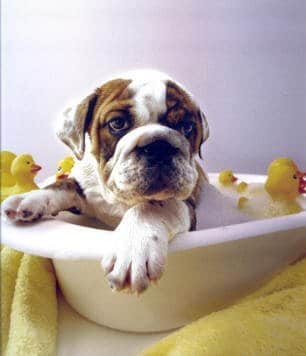
Dogs with folds!
- Make sure you rinse the folds well during washing.
- Equally important is that the folds are thoroughly dried as well, to prevent infections.
- Dry the folds under the eyes with a piece of cotton twisted around an artery clamp.
- Skin folds on the back that tend to remain damp in daily life can be remedied by placing a pad between them.
- If infections are present, often changing from red to purulent and also having an unpleasant odor, go directly to the veterinarian.
Brushing
Types of brushes
Brushes that are not rounded all around are rarely used by professionals.
- Grooming brush
- Straight pin brush.
- Rubber brush
- Universal brush
- Slicker brush
- Activet brushes:
Brushes with the Activet system have several advantages compared to.
> The user in the grooming salon:
time savings when detangling, dematting and de-shedding.
Less strain on the wrist and joints
Flexible in use
> The dog:
With correct use: less irritation of the dog’s skin
Be careful with dogs with sensitive skin, especially with the dematting brushes. - Types of Activet brushes:
> Mat Zapper, special dematting brush, available only in the small version: red.
> Activet: Universal Pro, small hard type: purple (a larger type exists: Mega).
> Activet: Pro, small soft type: green (a larger type exists: Mega).
Functions
- Preventing mats
- Removing existing mats
- Massaging the skin
- Stimulating blood circulation
- Removes dandruff, dirt, dead hairs
- Distributes natural oils
- Check for irregularities and parasites
How to brush?
- From back to front, bottom to top, layer by layer
How often to brush?
- Daily to weekly, depending on coat, season, activity
Polishing
- Glove with chamois, flannel, velvet, horsehair
- Remove loose hairs/pellets, make the coat shine
- Polish the coat in the direction of the hair
- Optional: spray bottle with lemon and dry with a chamois/bath towel
Combing
- Coarse/medium/fine comb, de-shedding comb, flea comb, with/without handles
- Check for mats, tidy the coat, prevent pain in areas where mats form
- Poor choice of comb can break or pull out hair; always choose according to coat type
De-shedding
- Coarse/fine-toothed de-shedding blade, Coat King, small rake, trim pumice stone, shedder
- Remove loose hairs from the coat, accelerate shedding
- At the end of the shedding period, brush in a coat-friendly manner
Detangling
- Brush, scissors, small rake, detangling comb, matt breaker, Coat King, mat splitter, Activet mat zapper
- Mats occur due to insufficient brushing, fine hairs, a lot of movement, moisture/grease in the beard/mustache, scratching/licking from allergies/wounds, etc.
- Common locations: lying side, behind the ears, inner legs, between toes, beard, mustache, cheeks, armpits, groin
- Gently loosen mats; if necessary, cut out, comb through or break them with a matt breaker or mat zapper
- Mud clumps: press flat with tongs, comb out the sand
Thinning
- Double/single/twin thinning scissors
- Regulate, create transitions, shape overly abundant hair by shortening/thinning
- The result is more natural than cutting; the hair root remains intact
- Never use thinning scissors in the same spot – it causes bald patches
Plucking
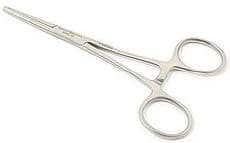
- Fingers, tweezers, artery clamp
- Pluck unwanted hairs according to breed standard
- Remove fine downy hairs in the ear to prevent infection
- If necessary, consult a veterinarian about eyelashes touching the eye
Nail trimming
- Essential for health and hygiene
- Dog groomer/veterinarian can help
- Puppy already getting used to having its feet and nails touched
- Treat with treats and praise – Day 1 to 7 gradually build up to a full trimming session
- Different types of nail clippers: scissor type, guillotine type, grinding tools
- Styptic powder for bleeding nail beds
- Steps for trimming: hold the paw, cut the nail straight across, only the tip, not past the curve, be careful with dark nails
- Grinding: a little at a time, support the toe, smooth rough edges, watch out for long hair
- Longer nails: prevent paw splaying, pain, deformity, and tendon injuries
Care for different coat types
Short-haired coats
For small dogs with short coats, regular grooming is essential to keep the skin healthy and remove excess hair.
Long-haired coats
Long-haired breeds such as the English Cocker Spaniel require more intensive grooming to prevent matting.
Curly coats
Curly coats such as in poodles and the labradoodle require special techniques to keep the curls looking nice without damaging the coat structure.
Seasonal care
During shedding, dogs need extra care. It is important to know how to deal with hair loss during this period.
Professional help
For more complex grooming tasks, it is advisable to seek help from professional dog groomers who have experience with different breeds and coat types.