


Did you know that English Cocker Spaniel colors are among the most diverse and fascinating in the dog world? These beloved hunting dogs display a stunning variety of coat colors — from deep black to warm gold, from parti-color to the unique roan patterns. However, behind this colorful display lies a complex world of genetics that many owners hardly understand.
The Cocker Spaniel coat colors are not just a matter of beauty, but also tell a story about the breed’s history and evolution. In addition, English Cocker Spaniel genetics play a crucial role in determining not only color but other traits as well. Care for an English Cocker Spaniel differs subtly by color — some shades require specific attention to maintain their shine. The color variations of English Cockers are so numerous that even experienced breeders are sometimes surprised by what can appear in a litter.
In this comprehensive guide we dive deep into the world of English Cocker Spaniel colors. We explore the solid-colored variants, the fascinating roan patterns, the genetic science behind each color, and provide practical advice for care and breeding. Whether you are a prospective owner searching for the perfect color, or an enthusiast who wants to learn more about these beautiful dogs, this guide will significantly deepen your understanding.
Solid-colored English Cocker Spaniels

The solid-colored variants of the English Cocker Spaniel form the foundation of this versatile breed’s color palette. Unlike the parti-colored and roan cockers, the solid cocker, as the name suggests, has primarily one dominant color, although a small white patch on the chest is completely acceptable according to the breed standard.
Black, red, gold and brown explained
First there is the black English Cocker Spaniel, which in its purest form (homozygous) has a deep raven-black coat. However, when a black cocker also carries a gene for another color (heterozygous), the coat can show subtle shading or a rusty sheen. This is because the dog, in addition to the dominant black gene, also carries a gene for, for example, red, brown or tan.
The red Cocker Spaniel is another beautiful example of a solid-colored variant. This color is caused by having two recessive red genes (ee). Although the skin and eye pigment in red cockers is usually normal, some dogs with this genetic makeup have a less pigmented nose. Notably, solid red cockers are 30% more likely to retain white markings on the face than black or brown puppies.
There is also the golden Cocker Spaniel, which usually has black pigment. A golden cocker with brown pigment also occurs but is particularly rare. The brown (also called liver or chocolate) Cocker Spaniel has brown pigment everywhere — from the coat to the nose, eyelids, lips, paw pads and even the nails. This color is genetically represented as ‘bb’.
What is sable and why is it rare?
The sable color variant is a fascinating pattern in which brown hairs have black tips. In fact, sable is a pattern where the tan markings become ‘wild’ and spread over the coat. In puppies the dark hair is often still dense, but as the dog ages the dark hair decreases and the lighter sable color becomes more dominant.
Sable is not necessarily rare as some claim – it is simply not bred as often within the show community. Furthermore, sable has not been a recognized colour for shows in the Netherlands since 2013, although sable cockers are still bred and in some countries such as Canada are still allowed to participate in dog shows. This explains why this colour variant is less common.
Black & tan and chocolate & tan variants

Finally, there are the solid-coloured cockers with tan markings. When both parents carry the tan gene, variants such as black & tan or chocolate & tan (liver & tan) can occur. The tan colour can range from straw-blond to hazelnut and is found in specific locations:
- Two distinct spots above the eyes
- On the side of the muzzle and on the jaw
- On the inside of the ears
- Between the upper arm and the forechest
- On the forelegs from toes to wrist
- On the hind legs from toes to hock
- Under the tail
Although the breed standard specifies nothing about the amount of tan, it is generally assumed that it constitutes about 10% of the entire coat. In red cockers the tan pattern may be present but is often difficult to see due to the low colour contrasts.
Understanding these solid-colour English Cocker Spaniel colours not only provides insight into the breed’s visual diversity, but also forms the basis for understanding the more complex colour variations that we will discuss in the following sections.
Multi-coloured and roan colours
After the solid-color variants we now enter an even more colorful world of the English Cocker Spaniel: the multicolored and roan patterns. These fascinating color variations add an extra dimension of visual diversity to the breed that enchants many dog lovers.

What are roan patterns?
Roan, or ‘schimmel’ as it is called in Dutch, is a distinctive color pattern where the base color is mixed with white hairs. This creates a speckled or marbled appearance. Unlike a spot or a simple color combination, roan consists of an even mix of pigmented and white hairs.
Genetically, the roan pattern is determined by the R-locus. The roan gene (R) is dominant over the non-roan gene (rr), which means a roan Cocker can be a carrier of the piebald gene, but a piebald Cocker can never be a carrier of the roan gene. This makes roan the most dominantly inherited pattern among multicolored English Cocker Spaniels.
Blue roan, liver roan and other variants
The English Cocker Spaniel colors within the roan spectrum are amazingly diverse. The most well-known variants are:
- Blue roan: a mix of black and white hairs that gives a bluish effect
- Liver roan (brown roan): brown hairs mixed with white
- Orange roan (orange roan): orange hairs mixed with white, can have either black or brown pigment
- Lemon roan (lemon roan): the most recessive roan color, lighter than orange
In roan patterns the dark spots are usually located on both sides of the skull, cover the ears and appear around the base of the tail. In addition, spots can occur anywhere on the body. A striking feature of roan Cockers is that their paw pads are always fully pigmented – black in blue roan and orange roan with black pigment, brown in liver roan and orange roan with brown pigment.
Parti colors: black-and-white, red-and-white, lemon-and-white
Besides the roan patterns there are the parti or ‘parti-coloured’ English Cocker Spaniels. These dogs have larger patches of a particular color on a white background. The most common combinations are:
- Black-and-white (with black pigment)
- Liver-and-white (brown-and-white, with brown pigment)
- Red-and-white (may have either black or brown pigment)
- Lemon-and-white (with black or light brown pigment)
For parti Cockers it’s important to know that the skin under the white coat is pink, while the skin under the colored areas is pigmented. In addition, parti Cockers have paw pads that are partly colored and partly pink.
Ticking versus roan: the difference
Although ticking and roan may look similar at first glance, there are important differences. Ticking consists of small colored flecks on an otherwise white coat, whereas roan is an even mixture of colored and white hairs.
Genetically, ticking sits between roan and parti in the dominance hierarchy: it is recessive to roan but dominant over parti. The T-locus, which corresponds to the usherin gene (USH2A), determines the development of ticking.
An important difference is that with ticking large white areas can occur, whereas this is not possible with roan [1]. In addition, ticking only develops after several weeks – puppies are born without ticking, and the small spots appear gradually.
In short, the multi-colored and roan patterns significantly enrich the color palette of the English Cocker Spaniel and make each dog unique. Because of the complex genetics behind these patterns, breeders are often surprised by the color variations that can appear in a litter – a fascinating aspect of cocker spaniel coat colors that contributes to the lasting popularity of this versatile breed.
The genetics behind the colors
Behind the beautiful colors of the English Cocker Spaniel lies a fascinating play of genetics. The genetic palette that determines coat colors is more complex than most owners realize and explains why some colors can suddenly appear in a litter.
Main color genes: A, B, E, S, R, T
The genetics of the English Cocker Spaniel are determined by several genes, each playing a specific role in color expression:
- A gene (Agouti): Controls the tan markings and determines patterns from black to sable
- B gene (Black/Brown): Determines whether the dog produces black or brown (liver) pigment. Black (B) is dominant over brown (b)
- E gene (Extension): Responsible for red color in English Cockers. A dog with two recessive red genes (ee) is red
- S gene (Solid): Determines whether the coat is solid-colored or has white markings
- R gene (Roan): Causes the roan pattern, where R is dominant over r (non-roan)
- T gene (Ticking): Creates small colored specks in a white coat
There are also other genes such as C (pigment depth), D (dilution), G (graying), and K (black dominance) that also affect the final coat color.
What is the difference between phenotype and genotype?
When understanding cocker spaniel coat colors, the distinction between phenotype and genotype is essential:
- Phenotype is how the dog looks physically – the visible color and patterns
- Genotype is the genetic makeup that does not always fully manifest in the appearance
For example, a dog can be phenotypically black while genetically a carrier of brown. In this case the dog has a Bb genotype (black carrying brown), but a black phenotype. This explains why two black cockers can suddenly produce a brown puppy.
How recessive genes reveal hidden colors
The phenomenon of ‘hidden colors’ is due to the action of recessive genes. A recessive gene only expresses itself when a dog has two copies of it (homozygous). As long as a dominant gene is present, the recessive gene remains ‘hidden’.
A striking example of this is the brown factor. A black cocker with genotype BB cannot produce brown puppies. However, a black cocker with genotype Bb (carrier of brown) can, when paired with another Bb carrier, produce brown puppies (bb).
The same applies to the red color. This is only visible when a dog has two recessive e-genes (ee). Two black dogs that are carriers of red (Ee) can together have red puppies.
Moreover, one gene can mask the presence of another. This explains why color variations in English Cockers can sometimes remain hidden for generations and then suddenly appear in a litter. It is this genetic play that continues to fascinate breeders and makes caring for the English Cocker Spaniel by color so special.
Eye and nose color with different pigments
In the English Cocker Spaniel the color of the eyes and nose is closely linked to the coat color – a fascinating aspect of English Cocker Spaniel colors that is often overlooked. This connection is not accidental, but is determined by the same pigment genes that influence the coat color.
How eye color changes in puppies
A surprising fact for new owners: all English Cocker puppies are born with blue eyes, regardless of their eventual eye color. The final color develops gradually. Puppies with black pigment (black nose) are born with dark blue eyes that change directly to dark brown. In contrast, puppies with brown pigment (brown nose) undergo a remarkable transformation – from blue to green and eventually to various shades of brown or hazel.
This color change is not random but follows a predictable pattern. In chocolate-brown puppies the blue iris color can vary from mid-blue to dark-blue shades before gradually changing.
Brown pigment and hazelnut-colored eyes
It is genetically impossible to breed truly dark eyes in a dog with brown pigmentation. According to the breed standard, English Cockers should have “dark brown or brown, never light” eyes. However, for liver colors, liver roan, and liver & white, “dark hazelnut-colored eyes in harmony with the coat” are permitted.
Dogs with liver or liver roan coats therefore have hazelnut-colored eyes that harmonize with their coat color. This hazelnut color lies on the color spectrum between dark and light brown, with a characteristically multicolored iris – often dark green or olive green around the pupil and medium brown or light brown on the outer edge.
Relationship between pigmentation and expression
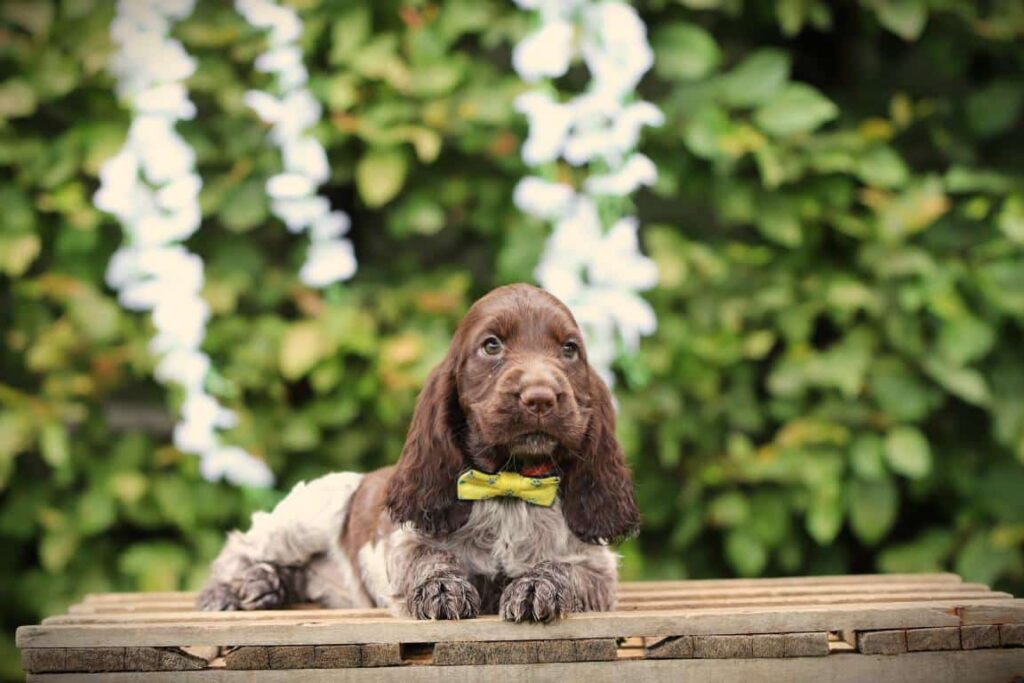
Iris color is determined by the amount and type of pigments. Appearance variations arise from differences in the ratio between two types of melanin: eumelanin and pheomelanin. Additionally, a notable characteristic is that the inner rim of the iris (directly around the pupil) is usually darker than the outer rim, in both black- and brown-pigmented dogs.
These subtle color differences contribute to the expression of the English Cocker Spaniel. Most black-pigmented Cockers have very dark brown eyes that appear almost black, which contributes to their soft yet alert look. When the coat color is diluted, the eye color will proportionally follow, enhancing the harmony in the dog’s appearance.
The Cocker Spaniel Club emphasizes the importance of following the breed standard regarding eye color and warns against trendy deviations such as blue or green eyes, which are not within the standard.
Breeding and inheritance of color
Breeding for specific English Cocker Spaniel colors is a fascinating process that requires precise knowledge of color genetics. In the past, rare colors such as sable were not valued and pups with these colors were sometimes even eliminated at birth, because it was suspected that other breeds were in the pedigree.
Which combinations produce which colors?
The color outcomes in breeding are predictable when you understand the genetic principles. When both parents are black without the recessive brown gene, you will get only black pups. However, if both parents carry the brown gene (Bb), theoretically 25% of the pups will be brown (bb). With a brown parent (bb) and a black carrier (Bb), about 50% of the litter will be brown.
What does it mean to be a carrier of a color gene?
Being a carrier means that a dog possesses a recessive gene without showing it. A black cocker with the genotype Bb has a black coat but carries the brown gene. These carriers are crucial for maintaining color variations in the English Cocker. When breeding two carriers, there is a chance of pups that do express the recessive trait.
Why some colors remain hidden for generations
Due to dominance relationships between genes, certain cocker spaniel coat colors can remain hidden for generations. When a dominant gene (such as B for black) is present, the recessive gene (b for brown) is masked. These hidden genes only become apparent when two carriers mate and both pass their recessive gene to a puppy.
Conclusion
The world of English cocker spaniel colors therefore proves to be amazingly diverse and complex. From deep blacks and warm chocolate tones to the fascinating roan patterns – each specimen of this beloved breed tells a unique genetic story. Moreover, the combination of different genes creates a color palette that can surprise even experienced breeders.
Especially the genetic interplay between the A-, B-, E-, S-, R- and T-genes ultimately determines not only the coat color but also the color of the eyes and nose. In addition, our analysis shows that recessive genes can remain hidden for generations before they suddenly appear in a litter of puppies.
The harmony between coat, eye and nose color undoubtedly forms an important aspect of breed-typical expression. When you choose an English cocker, you are not just choosing a color – you are choosing a complex genetic composition that expresses itself in a beautiful overall picture.
Although all color variants have their own charm, each color requires specific care to maintain its natural sheen. Black cockers, for example, can appear duller when they fade in the sun, while roan patterns often become more pronounced with age.
As an owner or enthusiast of this versatile breed, knowledge about the color variations of the English Cocker not only helps you understand your dog better, but also gives you insight into what to expect when breeding. After all, genetics remains a fascinating interplay of dominant and recessive genes that can sometimes lead to surprises.
This colorful diversity certainly contributes to the enduring popularity of the English Cocker Spaniel. Ultimately, it doesn’t matter what color your English Cocker is – their lively character, intelligence and devotion make every color variation equally valuable as a pet and companion.


